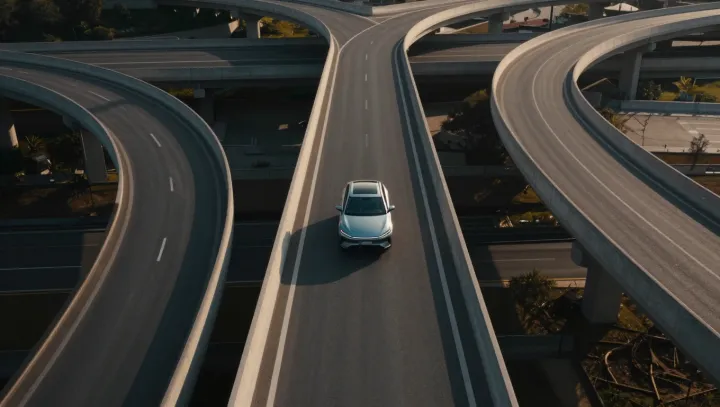
An empty interchange gives away the secret. No drama. No sudden twitch of the wheel. Just one clean arc that looks almost lazy while, underneath, a fast stream of micro-calculations runs between eye, brain, and hands.
The surprising truth is that calm drivers are not reacting less; they are predicting more, using what traffic engineers call preview distance and what cognitive scientists describe as feedforward control, so the car follows a pre-planned path instead of a jittery sequence of corrections. By fixing their gaze far ahead, they stabilize optic flow, the pattern of motion on the retina that encodes speed and curvature, which in turn lets the vestibular system and proprioception line up with what the eyes expect. That alignment trims motion sickness, trims steering entropy, and trims the odds of overcorrection when something small goes wrong.
Equally counterintuitive is the way a quiet steering wheel buys safety margin. A single, smooth input keeps tire slip angles small and keeps the vehicle closer to the center of its lane, which road-safety studies link to lower side-swipe and run-off crashes. Every extra micro-movement of the wheel is a new chance to amplify a mistake, especially at high speed, where lateral acceleration rises faster than most drivers sense. The serene driver is not being gentle for style; that driver is running a low-noise control loop, conserving attention so that when a real hazard appears, there is capacity left to act, once again, with just one decisive turn.