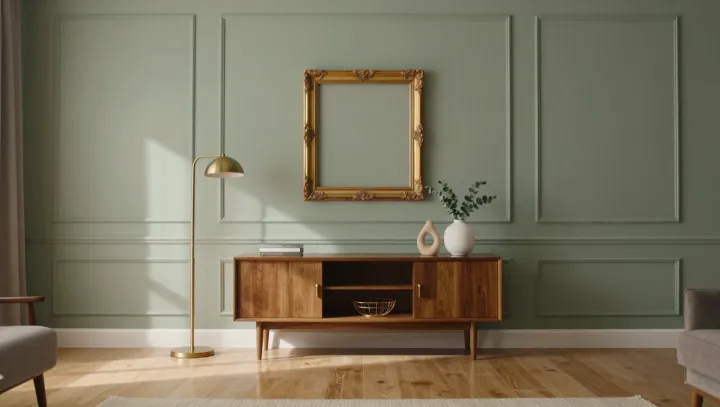
A strip of moulding does more psychological work than a whole new sofa. That thin profile carves fresh boundaries, and your visual cortex treats those lines as architecture, not decoration, expanding the mental map of the room far beyond its actual footprint.
Designers argue that height is a story, not a measurement, and moulding rewrites that story in seconds by giving your eyes new reference points and breaking up large blank planes. By slicing the wall into calibrated bands, it exploits size constancy and edge detection in the brain, encouraging you to scan vertically and horizontally so the shell reads as taller, wider and more layered than a flat surface of identical dimensions.
Warm brass, meanwhile, behaves like a silent amplifier. Small handles, frames or sconces introduce high-contrast anchors, and those micro flares of reflectance guide saccadic eye movements toward corners and junctions that used to vanish into shadow, leveraging specular reflection and luminance contrast to create the impression of depth and distance where the plan offers none.
The counterintuitive lesson is that density of detail, not quantity of furniture, builds a sense of curation, because the brain equates repeated material cues and clean alignments with order and intention, so a few centimeters of trim and a handful of brass accents can close the loop between ceiling, wall and joinery, tightening the composition even as the square footage stays absolutely fixed.