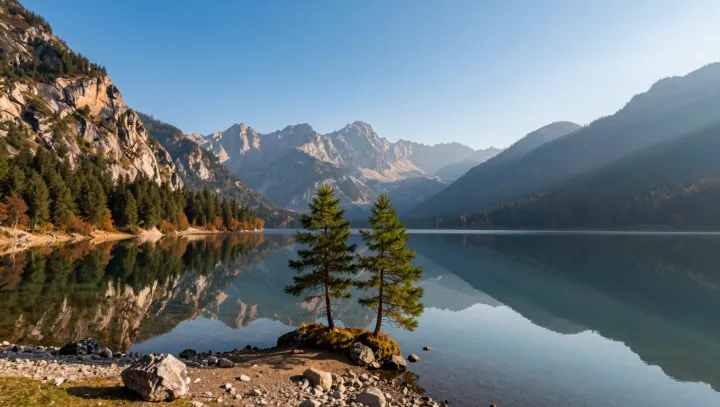
A mountain lake does not just reflect the sky. It edits it. Glassy water sends most incoming light back out as specular reflection, so clouds and stars appear almost undisturbed on the surface. Tiny ripples act like rotating mirrors, tilting that reflection without shredding it, which is why whole peaks can hang upside down in the basin like suspended drawings.
Yet the real story sits below the surface. When the water is extremely low in phytoplankton, dissolved organic matter and suspended sediment, very little light is absorbed or bounced sideways by Mie scattering. Shorter wavelengths then dominate through Rayleigh scattering within the water column itself, so blue photons penetrate deeply and are scattered back from tens of meters. The deeper that blue signal stays visible to an instrument or even a trained eye, the lower the concentration of impurities and the closer the absorption profile is to that of pure H2O.
This creates a strange optical split screen. At shallow viewing angles, your eye mostly catches surface reflection and the lake becomes a vertical copy of the sky. At steeper angles, more refracted light from depth reaches the observer, and the same lake turns into a luminous well of cobalt that functions as a crude spectrophotometer, quietly reporting on its own chemical and biological restraint.