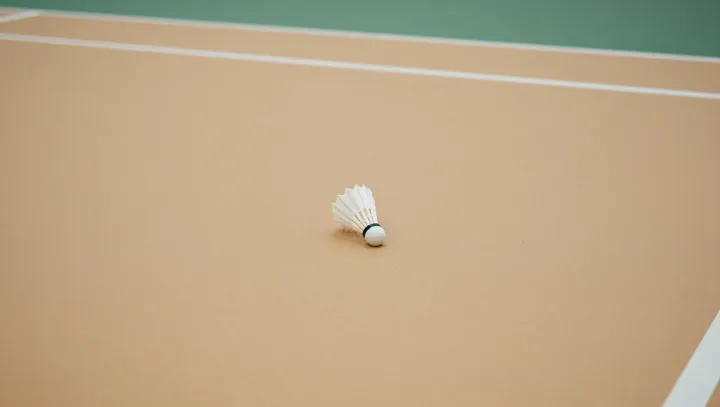
That violent crack at impact hides a quiet trick of physics. A shuttlecock is built to lose speed, not to keep it, and its feathered skirt turns air into an invisible brake. The cork nose takes the hit, but the real drama starts behind it, where geometry and flow do the hard work.
Counterintuitive as it sounds, the shuttlecock’s brilliance lies in being spectacularly bad at cutting through air. Sixteen overlapping feathers form an open conical lattice that forces turbulent flow, driving the drag coefficient to values far above those of a tennis ball or a streamlined projectile, so velocity collapses within a few court lengths while the flight path stays readable for players.
Equally striking is how orderly that chaos becomes. The mass is concentrated in the cork tip, while the feather skirt is light and wide, so aerodynamic torque constantly flips and holds the nose forward, and the spinning motion acts as gyroscopic stabilization, keeping the axis aligned with the trajectory as kinetic energy is bled away through viscous dissipation in the surrounding air.
The result is almost theatrical. A smash leaves the racket at extreme speed, yet the same object, without hidden springs or electronics, self-stabilizes, self-brakes and arrives near the floor in a slow, predictable arc, turning raw power into a soft, almost whispered landing through nothing more exotic than drag and clever design.