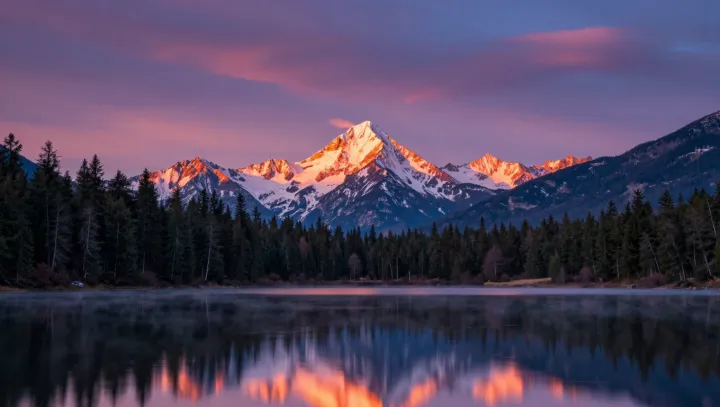
A mountain lake remembers longer than the sky above it. Not with mystic intent, but with physics that refuses to switch off as fast as the light does. When the sun drops, air temperature over the water falls sharply, yet the upper water layer, with its higher heat capacity, cools more slowly. That mismatch sets up a transient thermal inversion and a delicate change in refractive index just as the last band of orange light cuts across the surface.
What looks like a simple mirror is, in that moment, an unstable optical device. As the angle of incidence slides lower, Fresnel reflectance spikes, turning the lake into a near-metallic sheet for shallow rays while steeper rays still penetrate and scatter from suspended particles. Lingering snow on the slopes feeds cold, dense meltwater plumes that sink and stir, subtly roughening the surface and modulating the specular highlight. The eye reads those shifts as a fading afterimage of color, a memory that is not in the brain alone but encoded in fluid dynamics and radiative transfer.
The surprise is that the most ephemeral colors are driven by the slowest actors in the scene. Snowfields release chilled air and water on timescales far longer than the brief flare of sunset, so the microclimate they control keeps altering humidity, aerosol content and small ripples long after the direct solar disk is gone. On that cooling sheet of water, the sky’s last minutes are stretched into a quiet, physical echo: not a reflection of what is, but of what just was.