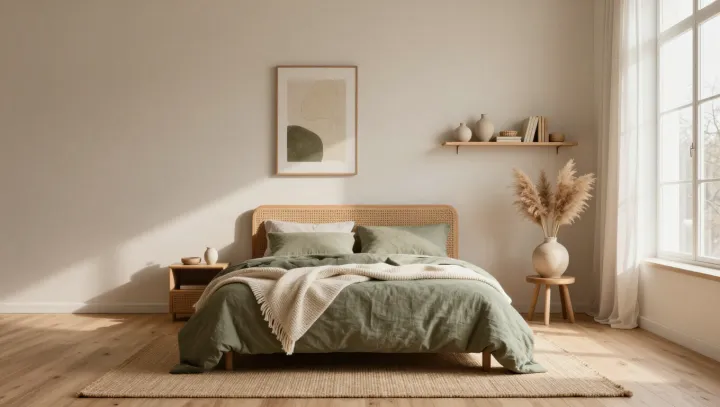
Flat walls in soft off white can do more for a cramped bedroom than another closet tower. Light, neutral surfaces strip away contrast, and contrast is what makes edges shout. When edges quiet down, the brain’s depth cues, including size constancy and figure ground perception, stop flagging the room as tight.
The bolder the pattern and color shifts, the smaller the footprint feels. That is the counterintuitive part. A dozen storage cubes or accent pieces promise order yet multiply visual units the eye must track. Each object becomes a separate datum. Cognitive load rises. Experiments in environmental psychology show that higher spatial complexity slows visual processing and shrinks perceived area.
A restricted palette of pale textiles, matte finishes, and low contrast bedding instead creates what designers call visual continuity. The floor, walls, curtains, and duvet read almost as one plane, so the room feels like a single volume, not a collage of fragments. Slim hardware, concealed handles, and flush fronts reduce occlusion and shadow lines, further stretching apparent width. In a small bedroom, space is not only a measurement. It is a perception that can be edited, quietly, by color, texture, and the decision to remove one more object rather than buy it.