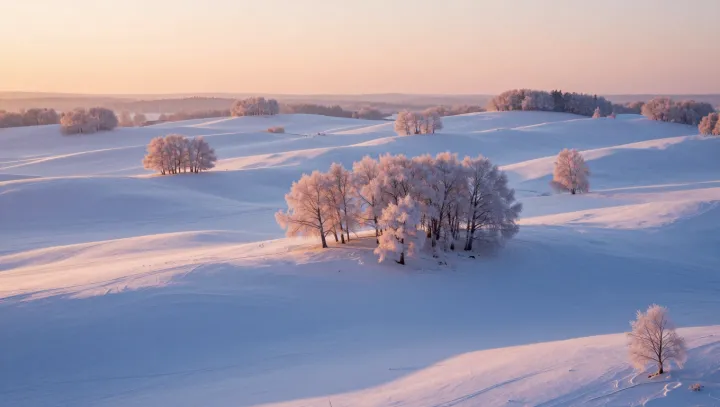
Colorless snow is not neutral at all; it is quietly biased toward sunlight. A winter field looks white only because its tightly packed ice grains bounce back almost every visible wavelength, turning the ground into a near-perfect diffuse reflector known in radiative transfer as a high-albedo surface. When the sun sits low, that same reflective sheet becomes a giant projection screen for the sky’s filtered light.
The real work starts far above the snow. At low solar angles, sunlight plows through a thicker slice of air, so shorter blue wavelengths are stripped away by Rayleigh scattering and Mie scattering on aerosols, leaving a beam enriched in reds and oranges. That warmer spectrum then meets the snowpack, where countless microscopic ice interfaces refract, internally reflect, and backscatter it, slightly favoring longer wavelengths as photons take extended paths through the grains. Pink appears where the sky light is still cool enough to mix residual blue with red; gold emerges where the beam has been purged of most shorter wavelengths and glances off the surface at shallow angles, concentrating the warmer end of the spectrum.
What feels like a poetic mood shift is really brutal geometry. Change the solar elevation by a few degrees, adjust aerosol optical depth, or alter grain size within the snowpack’s scattering matrix, and the glow vanishes, replaced by flat white. Hold the angle, keep the ice crystals clean and fine, and the field answers with color far richer than the sun itself.