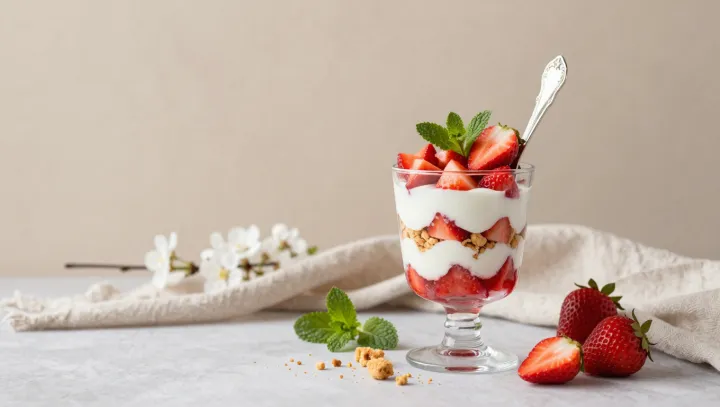
A parfait can taste bold and sugary while the recipe barely changes. That is not culinary magic; it is sensory engineering aimed straight at the brain’s flavor circuits. When thick yogurt alternates with strawberry slices and a dry, crunchy layer, the tongue and nose receive a staggered feed of signals that exaggerate sweetness far beyond the lab-measured sugar content.
The key claim is simple: structure sweetens. As the spoon breaks a stratum of crumbs into the softer yogurt, mechanical contrast boosts attention in the somatosensory cortex, and attention, research shows, amplifies perceived sucrose intensity. Moisture gradients matter as well; dry crumbs momentarily reduce saliva, so dissolved sugar in the next hit of yogurt and fruit creates a sharp spike in concentration right at the taste buds, where T1R2/T1R3 sweet receptors sit waiting.
More powerful still is aroma. Strawberry volatiles move upward through retronasal olfaction with every swallow, so the brain’s flavor integration hubs, including the orbitofrontal cortex, bind smell, taste, and texture into one inflated judgment of sweetness. Bright red fruit against pale yogurt adds a visual cue; experiments on crossmodal perception show that stronger color saturation alone can bias sweetness ratings. Build the parfait tall, keep the layers distinct, and the brain fills in sugar that never went into the bowl.
On the spoon’s surface, then, sits a small argument against the idea that cutting sugar must blunt pleasure: change the architecture of dessert, and the nervous system quietly rewrites the taste.