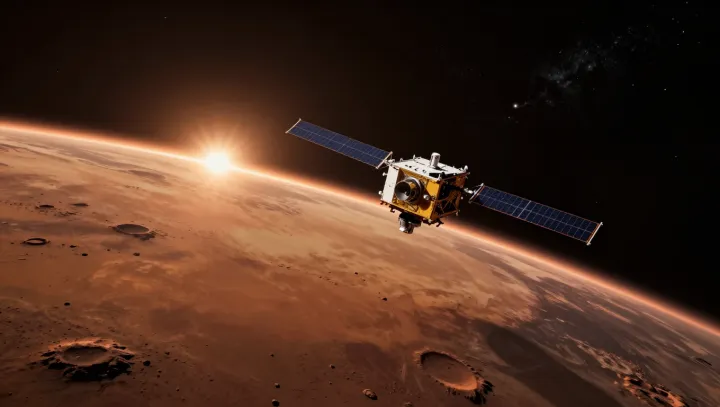
Sunrise here is not gentle. Against the bright limb of a planet, the solar-powered probe cuts its arc, its trajectory already locked into a narrow corridor where a small error means lost mission rather than pretty sky.
This flyby is less a pass and more a controlled fall, because orbital mechanics and the gravity well squeeze the vehicle toward the planet while guidance software hunts for the only path that threads between impact and escape. Thin as it is, the upper atmosphere still bites; engineers rely on aerobraking, the conversion of kinetic energy into heat and drag, yet must stay below structural limits on thermal stress and dynamic pressure that the carbon composite frame can survive.
The real constraint, though, comes from light. Solar flux near this orbit falls sharply with distance, and those panels, already dusted and degraded, feed just enough current to keep reaction wheels spinning and attitude control aligned. Instruments compete for wattage in a silent budget war, so every imaging burst, every burst of telemetry, is scheduled against battery depth-of-discharge curves and power system margins. From a distance the probe just glides through morning; on board, each second is a negotiated truce between gravity, drag and a failing trickle of sunlight.