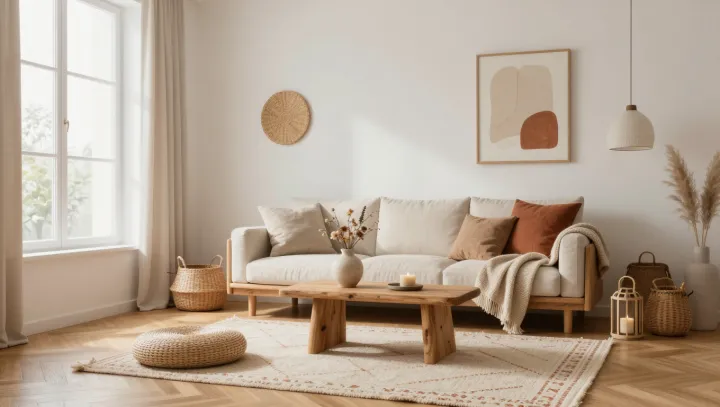
Color, not clutter, may be the real agitator in many homes. Research on environmental psychology shows that high-contrast palettes trigger more saccadic eye movements and greater cortical arousal, pushing the autonomic nervous system toward a mild fight-or-flight stance. Swap to warm neutrals and the field of vision suddenly carries fewer competing edges, so the brain spends less metabolic energy on constant scene parsing and more on baseline regulation.
Texture works like a dimmer switch for anxiety. Woven fibers and matte finishes scatter light, lowering luminance contrast and reducing the micro-glare that quietly keeps the visual cortex on alert. When surfaces stop shouting, the prefrontal cortex handles less irrelevant input, which reduces cognitive load and allows parasympathetic pathways to dominate, slowing heart rate and easing muscle tension without a single item leaving the room.
Low-profile wood furniture adds a final, almost sneaky, intervention. By dropping sightlines, these pieces compress the vertical field the brain must survey, shrinking perceived environmental complexity and, with it, ambient vigilance. Wood’s organic grain introduces low-frequency visual patterns associated in multiple studies with lower electrodermal activity, giving the body many of the calming benefits people usually chase through ruthless decluttering, yet preserving every book, mug and memory in place.
A room can stay just as full, yet feel radically quieter; the objects remain, but the nervous system no longer treats them as a crowd.