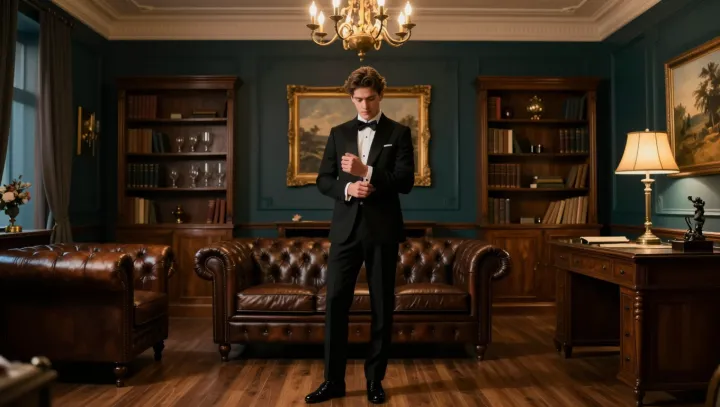
Low, amber light does the quiet status work that logos think they are doing. Against that glow, a black tuxedo becomes a high-contrast object, and high contrast is exactly what visual cortex neurons fire for when they need to prioritize one figure over a noisy background.
The sharper signal, though, is not the color but the order. Status, research keeps showing, is read less from price tags than from symmetry, alignment, and clean geometry. Tailored lapels form predictable angles, shirt placket and bow tie create a central axis, and the body becomes a near-bilateral pattern; that taps into the brain’s bias for symmetry as a proxy for competence and control, supported by work on facial symmetry and mate choice in cognitive neuroscience.
Logos, by contrast, are noise. They add visual entropy, pull the eye off the midline, and force observers into a slower, semantic route: recognize brand, recall its marketing, then infer rank. A plain tux under warm, subdued light skips that lag. It feeds straight into low-level feature detection and social schema activation, where uniforms, evening wear, and stage settings have long been coded as authority contexts. The result is brutal: the less the garment says in text, the more decisively the brain completes the story.