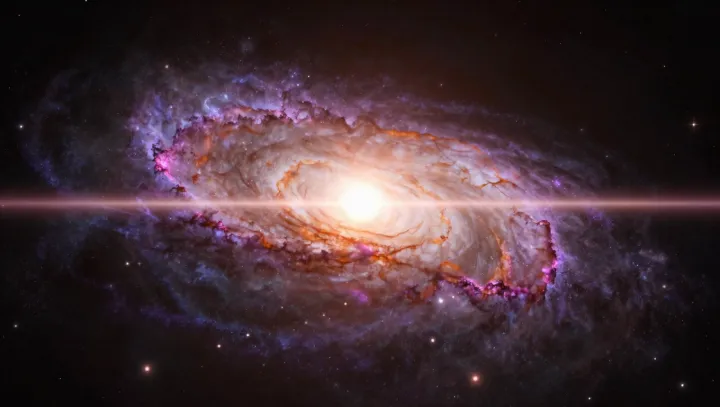
A dark boundary can be the brightest engine in a galaxy. Around a black hole, the event horizon stays mute, yet the space just outside turns violently luminous as gas in the accretion disk heats to extreme temperatures and radiates across the spectrum.
The real trick is not light but extraction. As plasma spirals inward, it shears magnetic field lines, amplifying them into rigid structures that thread the spinning black hole. In that magnetosphere, general relativity and magnetohydrodynamics meet, and rotation energy becomes available like tension in a wound spring.
From this stressed geometry, jets erupt. Particles are accelerated to relativistic speeds along the magnetic poles, guided into narrow beams that pierce the host galaxy. The Blandford–Znajek process describes how the hole’s spin and magnetic flux combine to pump energy outward, even while no photon escapes the horizon itself.
So the paradox is only superficial. The black hole does not shine; its environment does. Gravity traps light inside the horizon, but just outside, curved spacetime, differential rotation and magnetic fields collaborate to launch jets bright enough to outshine billions of stars.