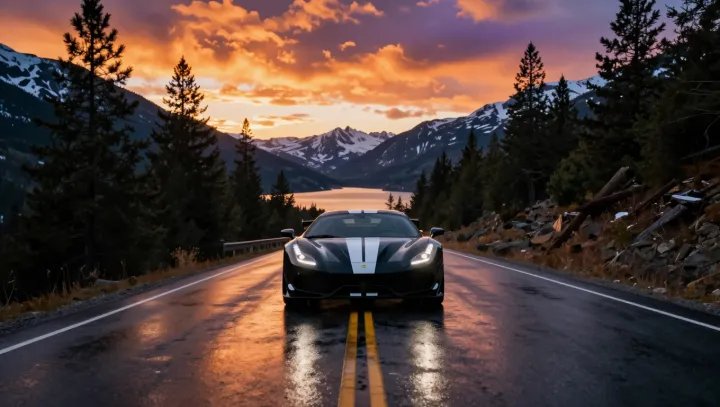
Sunset on a mountain road rewards restraint more than horsepower. The car that eases off early, rather than the one that snaps through gears, tends to arrive first because it spends less time fighting the limits of friction and mass and more time staying within them.
Speed without foresight is a kind of mechanical arrogance. Vehicle dynamics, from weight transfer to tire slip angle, punish late reactions; by the time a driver sees the tightening radius of a blind corner, inertia and kinetic energy are already in charge, enlarging every minor misjudgment. The driver who brakes while the guardrail is still a concept, not a blur, converts information into time, and time into grip. That margin is invisible on the straight, yet it decides who must stab the brakes in panic and who can feed the car into the apex in one calm, continuous arc.
The paradox is simple. The faster mind creates the faster car. Anticipation functions like a second set of brakes, extending the effective contact patch far beyond rubber and asphalt, into the space where hazard perception and risk modeling quietly run. On that fading strip of light between rock face and drop-off, victory belongs less to the loudest engine and more to the driver who slows soon enough that physics never gets the final word.