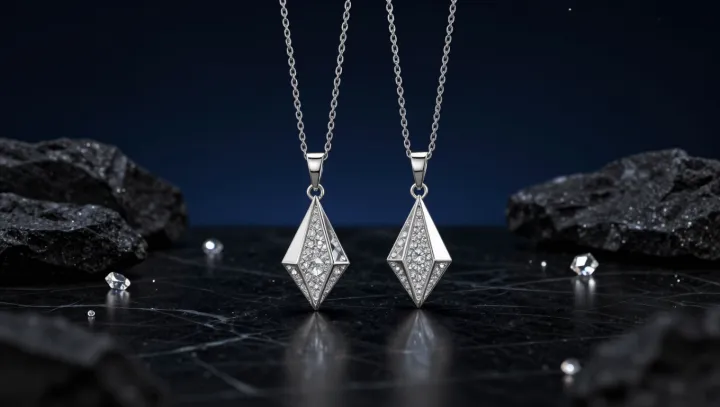
Two small triangles can outshine an entire chain. Not in weight, not in carat, but in how the eye and brain process order. When gold is pulled into sharp, isosceles pendants, their edges act like tiny optical devices, concentrating reflections into clean vectors of brightness instead of the soft, noisy shimmer of a rounded link.
Luxury, in this case, is mostly a story about information density. Those crisp outlines create high-contrast boundaries that the visual cortex segments with ease, a kind of on-the-spot edge detection that feels deliberate rather than accidental. Symmetry then steps in as a cognitive shortcut: bilateral balance has long been tied to judgments of quality and even biological fitness, so a pair of matched triangles quietly suggests control, calibration and cost, even when the alloy is identical.
Price, or what looks like it, is therefore coded less in metal than in math. The triangles signal precision engineering, hinting at tolerances, tooling and design intent, while the plain chain reads as background infrastructure. One form says mass, the other says measure, and measure is what the brain keeps mistaking for money.