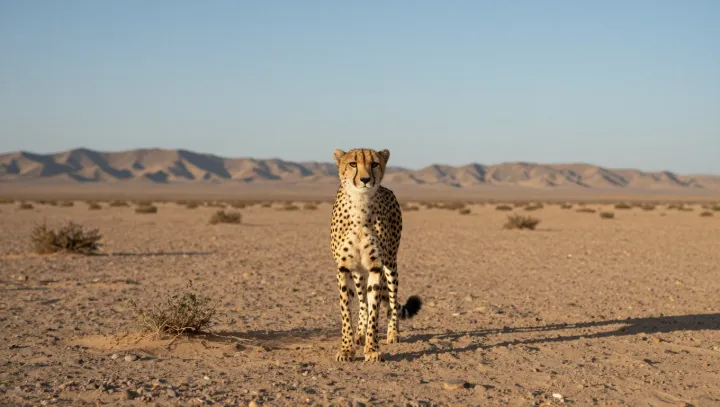
Spotted fur cheats the eye. A flat sandy coat only works when the background matches almost perfectly, so any shadow, twitch, or outline stands out as a clean target for a predator’s visual cortex that is tuned for edge detection and contrast.
By contrast, bold black spots act like visual noise. They break the animal’s contour into fragments, so the outline no longer reads as a single continuous body but as scattered patches that blend with clumps of grass, cast shadows, and gaps of light. This is classic disruptive coloration, a strategy biologists describe as interfering with object segmentation in the brain’s early image processing stages, where neurons fire for boundaries and moving shapes rather than for colors alone.
Spots also sabotage motion tracking. When the animal moves, each patch shifts in a slightly different way against the vertical blades, confusing motion-sensitive ganglion cells that try to lock onto a coherent form. A plain sandy body gives those cells a stable, unified block to follow. A spotted coat turns that block into a broken signal, harder to isolate, harder to chase, and easier to miss in the restless shimmer of open grass.