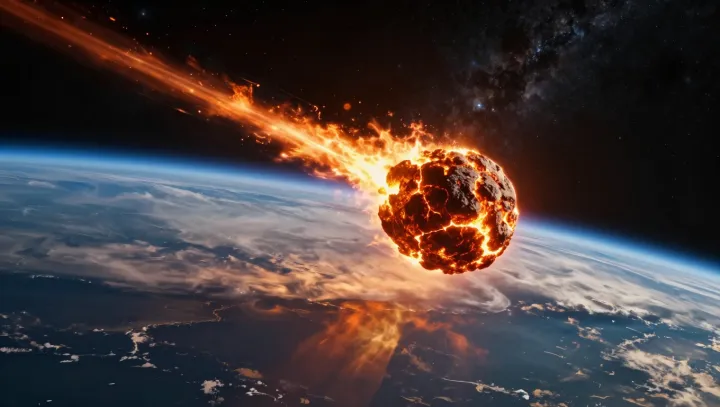
The strange part is not that a small asteroid can flatten a continent. The strange part is that it almost never gets the chance. A rocky body only a few kilometres wide, hitting at tens of kilometres per second, carries kinetic energy on the order of hundreds of gigatons of TNT, far beyond the combined yield of every nuclear warhead built by any state.
Rarity, though, is baked into orbital mechanics. Near-Earth objects of that size are scarce, their orbits only rarely crossing both Earth’s path and Earth’s exact position in space at the same instant, a three-way alignment that statistical models place at intervals far longer than the span of human records. Earth’s atmosphere also acts as a high-altitude filter: smaller intruders deposit their energy as airbursts, like the Tunguska event, while only the largest retain enough structural integrity to excavate a crater and inject dust into the stratosphere.
So the imbalance is stark. Planet-scale power, almost never deployed. Impact probability curves show that humanity lives in a narrow observational window, long enough to catalogue craters and extinction layers, far too short to watch the full dice roll of the Solar System play out overhead.