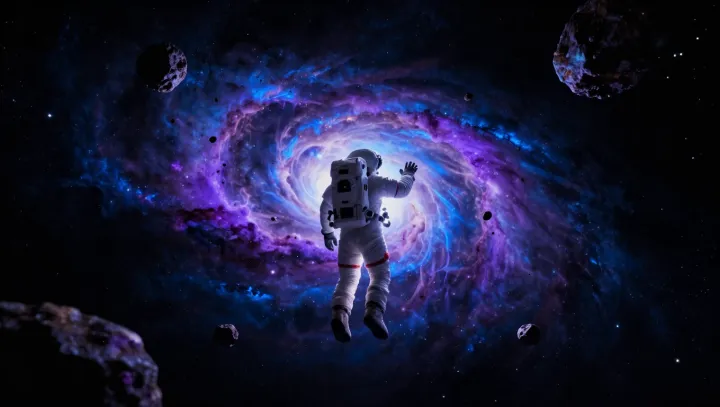
Silence would be the astronaut’s first lie. Nothing in the scene is calm. Vacuum strips heat by radiation alone, while the suit’s life-support system fights a losing thermodynamic battle against extreme temperature gradients from the glowing vortex of plasma.
Most dangerous is not the void, but the radiation. High‑energy photons and charged particles from the vortex would hammer the body, punching through tissue and suit alike, driving DNA double‑strand breaks and ionization in blood and cerebrospinal fluid. Short exposure gives nausea and transient visual flashes as particles strike the retina; longer exposure raises cancer risk and can destabilize cardiac conduction. No sound carries, yet every organ registers the assault as oxidative stress surges and cellular repair pathways saturate.
Weightlessness would feel less like freedom than erasure. With almost no gravity gradient, the vestibular system loses its reliable reference, and the brain’s parietal cortex must improvise a new internal map. Short term, that means disorientation, space motion sickness, disturbed proprioception. Over time, microgravity drives fluid toward the head, elevates intracranial pressure, flattens the back of the eye and alters optic nerve sheath diameter, shifting vision and cognition together in subtle, poorly reversible ways.
Psychologically, the threat sits in the mismatch between spectacle and sensation. The vortex floods the visor with structured light from synchrotron emission and bremsstrahlung processes, yet the body feels almost nothing: no wind, no rumble, no weight. That sensory vacuum invites panic or dissociation as the prefrontal cortex tries to assign meaning to an event stripped of normal cues. Drifting closer, the astronaut would likely experience a shrinking sense of time, a narrowed field of attention, and a final, clinical truth: physics keeps acting long after subjective experience has thinned almost to zero.