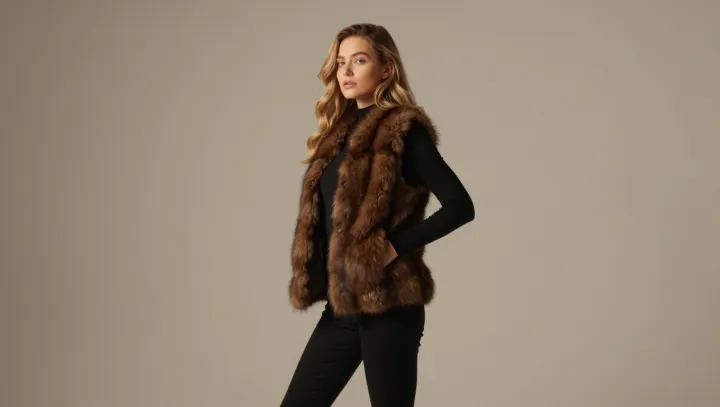
That vest is not decoration. It behaves like a structural beam dropped onto a quiet black shell, rerouting how the eye reads the entire portrait before it ever reaches the face. Against the uninterrupted field of black—top, trousers, even boots—the fur trim forms a sharp value break and a different surface frequency, so the garment stops being “cute outerwear” and starts operating as visual architecture.
Authority here does not come from logos or sharp tailoring; it comes from hierarchy. Matte black basics recede, acting as low-luminance ground, while the vest advances as the dominant form, its raised pile catching light in uneven bands. That shift in reflectance and micro-texture creates edge definition around the torso, almost like a framing device, so the subject appears more anchored, less ornamental, more like the fixed column around which the rest of the frame must organize.
The negative space around that column is doing quiet work. Clean, dark sleeves and legs read as uninterrupted voids, isolating the furry volume at center and giving it room to breathe. Cropping that leaves air above the shoulders and along one side exaggerates the effect: the viewer reads a strong vertical mass flanked by calm emptiness. The portrait stops feeling like a spontaneous outfit shot and starts to resemble a controlled study in mass, contrast, and winter-ready density, with authority communicated not by expression, but by how the clothes occupy space.