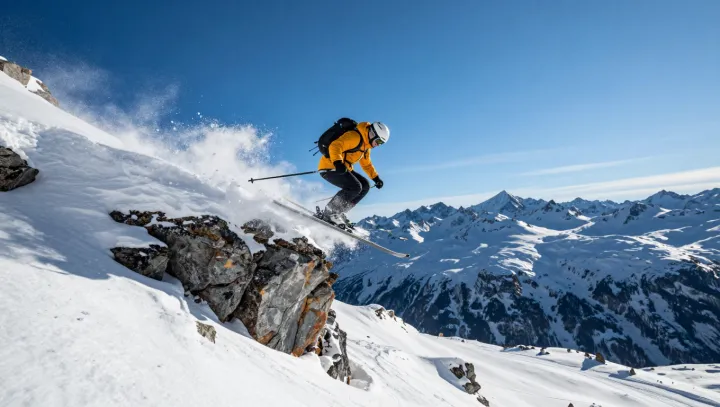
Snow, not bravery, decides whether a house-high drop is a stunt or a hospital trip. Big-mountain skiers treat that white surface as engineered foam, reading density and moisture like a lab report before they ever point their tips over the edge, because a soft, cohesive layer can extend the stopping distance just enough to tame violent impact forces.
The real trick is that these athletes do not fall, they reattach. Just before the lip, they compact muscles and joints into a loaded spring, then release on contact so ankles, knees, and hips lengthen the deceleration path; basic impulse–momentum physics says stretching that path in space and time slashes peak ground reaction force. Edge angle comes next. By rolling skis aggressively onto their sides, they slice into the snowpack and redirect kinetic energy sideways into a high-speed traverse instead of straight down into cartilage.
What looks reckless is actually ruthless timing. Hit too stiff, and the body becomes a rigid column that transmits force directly to bone; absorb too softly, and the skier folds, dumping mass into the slope with no structural support. The best riders sync their center of mass with the slope angle, driving edges just deep enough to engage shear strength in the upper snow layers while avoiding the grabby drag of wet, heavy slabs. From afar it reads as a clean glide. Up close it is controlled violence, precisely moderated by edge, joint flexion, and the microscopic structure of frozen water crystals.