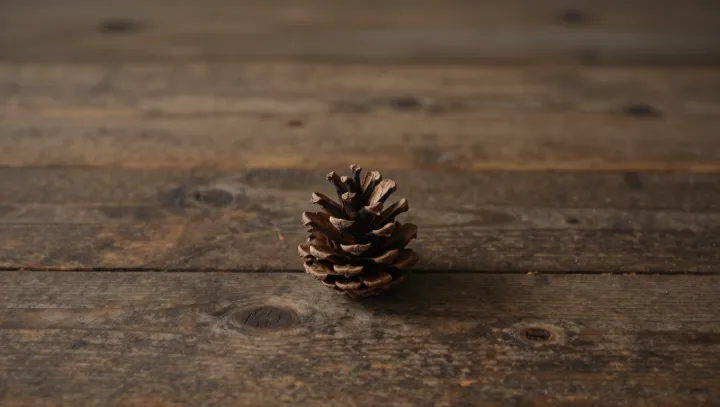
The strange part is not that a pine cone falls at random; the strange part is that chance never touches its geometry. On the forest floor, the cone looks discarded, yet every woody scale still locks into two families of spirals whose counts nearly always match consecutive Fibonacci numbers, a pattern also traced in hurricane cloud bands and in the luminous arms of disk galaxies.
This order begins long before the cone drops. At the growing tip of a pine shoot, new scale primordia push into existence where mechanical stress and auxin concentration reach a threshold, a process botanists describe through phyllotaxis and reaction–diffusion dynamics. Short sentences first. Those primordia pack as tightly as possible around a circular meristem, and that packing problem, solved under constant radial expansion, drives organs into a logarithmic spiral that naturally yields Fibonacci phyllotactic ratios.
So the cone does not decide anything when it falls; it merely preserves a frozen growth record written by differential growth rates and minimization of energy. Galaxies and hurricanes, guided instead by gravity, Coriolis forces, and conservation of angular momentum, arrive at related logarithmic spirals for a different energetic reason, but with eerily similar geometry. The pine cone, mute and fallen, still carries that shared script of curvature in its scales.