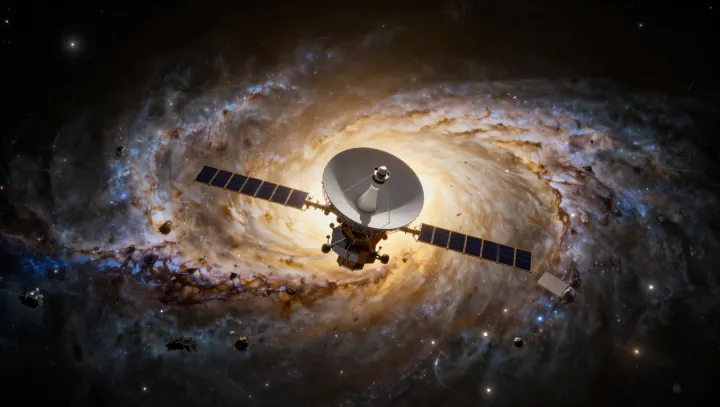
That the Moon and a spacecraft obey the same equations is the least interesting part of the story. Far more telling to astronomers is how those objects acquired their orbits in the first place, through a violent accretion history for the Moon and through deliberate propulsion sequences and guidance software for the vehicle.
Natural, in this context, is really a judgment about origin and entropy. The Moon’s path is an emergent outcome of many-body gravitational dynamics and impact events, with no encoded blueprint, just initial conditions set by geology and collision physics. A spacecraft, by contrast, carries design documents, control algorithms and burn schedules that pre-compute its trajectory using Newtonian mechanics and orbital mechanics as tools, turning raw gravity into an engineered outcome.
So the label is not about different physics. It is about where the information that shapes motion resides. For the Moon, it is smeared through chaotic formation and long-term tidal evolution. For the spacecraft, it is concentrated in human-made hardware, in guidance, navigation and control code, and in the timing of engine thrusts that sculpt a specific path through the same gravitational field.