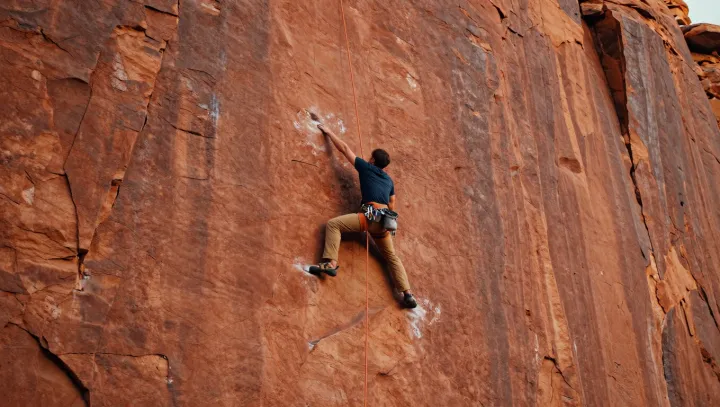
Color, not courage, decides who stays upright on slickrock. On desert sandstone, what looks like one smooth orange plate is actually a patchwork of subtly different minerals and abrasion patterns, and riders train their eyes to treat each faint band or freckle of darker stone as a code for grip, slope, and risk.
The harsh truth is that crashes often start where the rock only seems uniform. Human vision is tuned to edge detection and luminance contrast, so a slightly darker streak signals a change in porosity or cementation that alters friction coefficients under the tire. Tiny ribs cast micro‑shadows; those shadows betray hidden steps just millimeters high that can still deflect a wheel at speed. A pale, sun‑bleached sheen often means polished, low‑texture quartz grains, while warmer, rougher patches hold more micro‑pitting and therefore more mechanical interlock for rubber.
Skill in this terrain is less about reflexes than about building a personal library of rock cues. Riders repeatedly pair what their cones and rods detect with what they feel through knobs and sidewalls, effectively running rapid‑fire pattern recognition long before any conscious decision. That is why a faint grey film of desert varnish reads like a warning line, and why a narrow, lighter ribbon across a slab can serve as a safe corridor, as legible to a trained eye as painted stripes on asphalt.