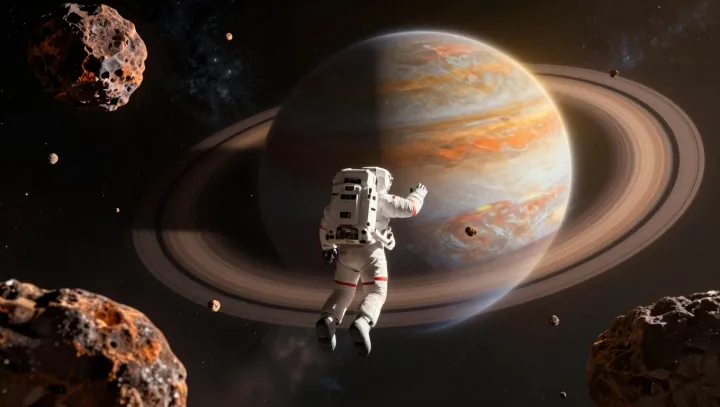
Vacuum gives no second chances. Against asteroids and gas giants, survival depends less on courage than on physics and automation. The lone figure in a suit is only the last layer of a stacked defense that starts with orbital mechanics, treating the whole region like a moving equation that predicts where the rocks and ice will not be.
Paradoxically, the safest astronaut is the one who floats the least. Microthrusters, tied to inertial measurement units and radar, keep the suit locked into a pre computed trajectory that avoids dense debris fields, exploiting stable Lagrange points and resonant orbits the way a pilot uses air corridors. Short burns trim relative velocity, because impact energy scales with the square of closing speed, and even a grain of sand becomes a rifle shot at orbital velocity.
True protection, though, looks almost unromantic. A compact habitat or maneuvering pod carries a Whipple shield, its sacrificial outer layer designed so hypervelocity particles vaporize and spread before they hit the pressure hull. Around the astronaut, lidar, phased array radar and optical tracking feed a collision avoidance algorithm that issues automatic delta v maneuvers when any track crosses a narrow kill cone. The suit itself adds layered composites and flexible ceramic plates over life support lines. Silence, not heroism, marks success; the astronaut never feels the fragments that missed by design.
Risk never reaches zero. It only shrinks as guidance software grows more precise and shield mass is traded against fuel and life support in mission design.