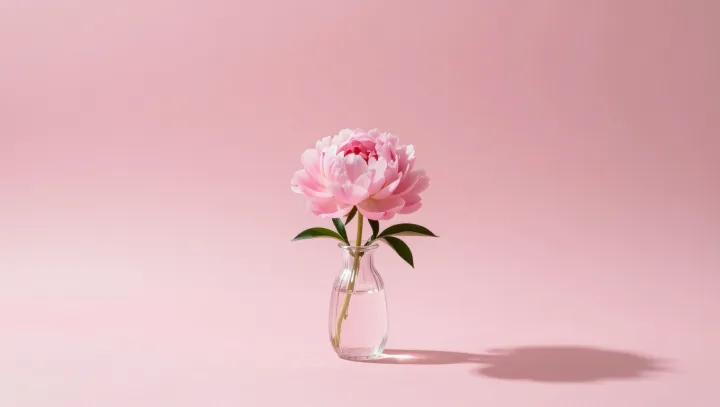
A lone pink peony on clear glass can look richer than a florist’s showpiece. That is not sentiment; it is perception engineering. With only one bloom, the eye has no competition for attention, so the brain assigns it higher value, a known bias in consumer psychology where scarcity and salience inflate perceived worth.
Luxury, at its most convincing, often works by subtraction. The empty air around the stem acts as negative space, a visual equivalent of silence in acoustic design, allowing the petal structure, the gradation of color, and the subtle translucence of water to register with almost forensic clarity instead of being drowned inside a crowded dome of flowers.
Crowded bouquets tend to read as cost accounting: more stems, more money, less meaning. One peony, isolated and upright, borrows codes from gallery curation and product staging, where a single object on a plinth signals rarity and intent. The plain glass vase behaves like a neutral frame, stripping away decorative noise so that the slightest curve of the bloom feels like excess.
What looks minimal is, in practice, a kind of visual austerity that heightens every small luxury the flower already owns: the generous head, the slow unfurling, the way pink drifts toward white at the edges. Luxury here is not added by buying more. It is revealed by getting out of its way.