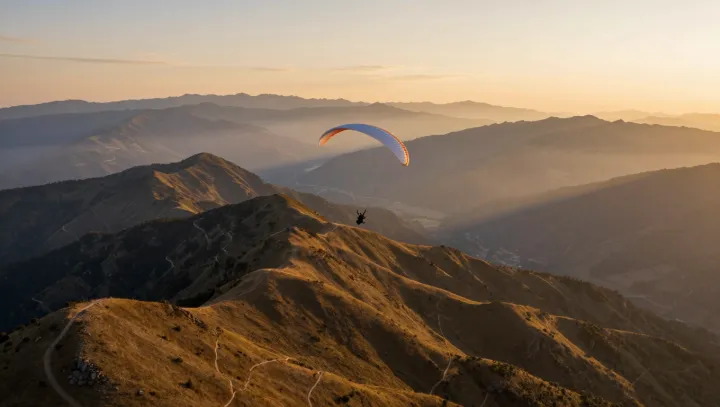
Silent air is rarely still; that is the basic cheat behind long paraglider flights in the soft light above mountains. What looks calm from a valley hides slow, structured motion shaped by ridges, slopes and cooling rock, motion that a flexible wing can convert into hours of unpowered travel.
The first surprise is that a paraglider always sinks. No exception. Its airfoil, with higher velocity over the top surface and lower static pressure beneath, produces lift, yet the wing still drifts downward through the surrounding mass of air at a modest sink rate. The trick is simple: if the surrounding air itself rises faster than that sink rate, the pilot climbs, even though the wing is technically descending through its local flow field.
Mountain terrain quietly manufactures that rising air. During the day, slopes heat, triggering buoyant parcels that detach as thermals, a textbook example of convective instability and adiabatic cooling in action. Later, when sun fades and classic thermals weaken, broad, smooth updrafts persist along ridgelines and in convergence zones where two air masses meet and are forced upward. The paraglider, trimmed to a stable angle of attack with mostly laminar flow over the canopy, can surf those gentle elevators with almost no apparent motion or noise.
What seems almost mystical is mostly precision timing and geometry. A pilot who keeps the wing inside narrow bands of orographic lift, or within the glassy leading edge of a residual thermal, effectively taps an invisible escalator built by the mountain’s shape and the atmosphere’s stratification. The wing adds nothing, burns nothing, hums not at all; it simply trades altitude, sink rate and rising air until dusk turns the last slow updraft flat.