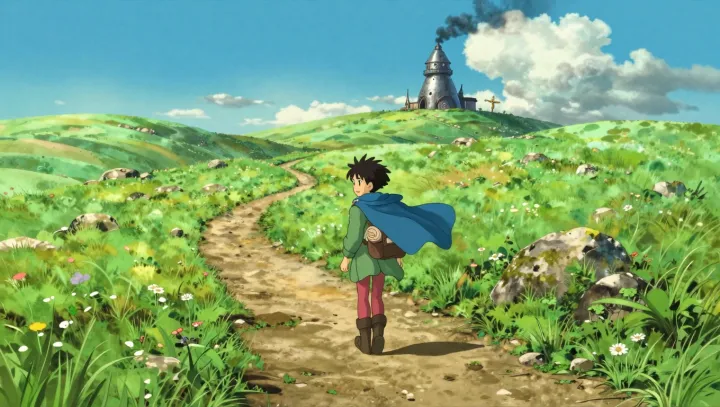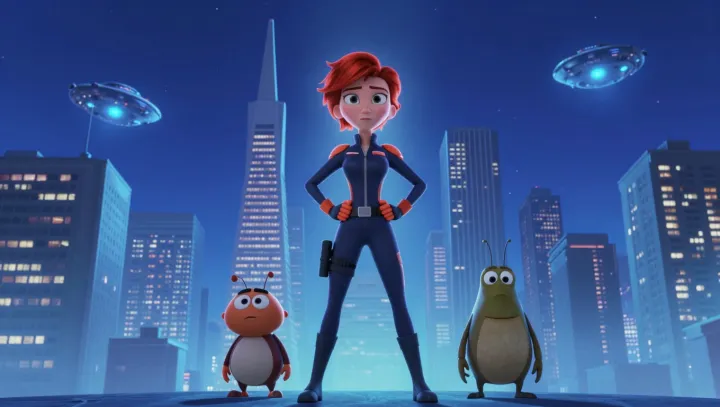
Glowing glass grids shrink first. Tower blocks recede like toys while a girl’s silhouette swells past the skyline, a visual trick that quietly rewires a deep bias in human perception. Cognitive scientists note that humans show size constancy and distance compression in vast scenes, so cities already feel abstract and far. Make the heroine larger than that abstraction, and the brain stops reading her as a fragile figure in danger and starts reading her as the reference scale itself.
Power, then, is not just costume or plot. It is the moment animators hijack depth cues, horizon lines and atmospheric perspective to turn existential awe into character control. Environmental psychology shows that open, empty spaces trigger hyper‑vigilance and a faint threat response, the same circuitry tied to the amygdala that fires in cliffs, oceans, endless plazas. By stacking a colossal heroine in front of that void, artists let viewers keep the charge of danger while relocating it outside her body.
The odd twist is that she still reads as vulnerable. Facial close‑ups, slowed eyelid blinks and subtle motion parallax preserve human scale inside a nonhuman frame, so identification does not break. The viewer feels small, yet aligned with the giant, not the city beneath her. That split allegiance, between cosmic backdrop and oversized body, is where these images smuggle in a new template for power: not safety from vastness, but ownership of it.