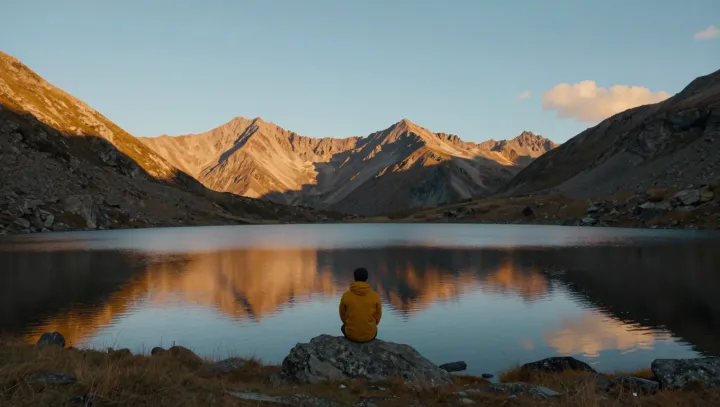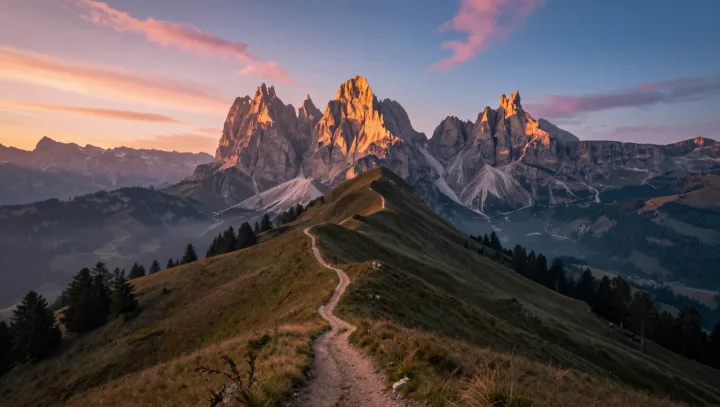
Cold light can burn. Near the horizon, the Sun looks tired, its power on skin and soil sharply reduced, yet the same low disk turns ridgelines into apparent flame. The reason sits in geometry first: that shallow angle forces every photon through a far longer slice of air, extending the optical path length and stripping away much of the short wavelength blue through Rayleigh scattering while aerosols add Mie scattering that favors warm tones.
Color here is not a gentle bonus; it is the residue of loss. By the time this filtered beam reaches high peaks, it is energy poor but spectrally skewed, dense in reds and oranges that glance almost sideways across fractured rock. Fresh snow behaves as a diffuse reflector, but jagged faces do not. Iron-rich feldspar, hematite stains, and thin films of weathered biotite selectively reflect longer wavelengths, so each ledge becomes a targeted mirror for that narrowed spectrum, while shadowed gullies stay blue and cold.
The mountain is complicit. Sharp relief amplifies contrast, and a low solar incidence angle stretches the boundary between lit and unlit zones into hard, knife-like edges that human vision interprets as drama. Combined with the eye’s higher sensitivity to warm hues under low luminance, this produces the paradox: a fading star, delivering less heat and weaker irradiance, still has enough carefully filtered, mineral-tuned light to make stone look like molten metal.