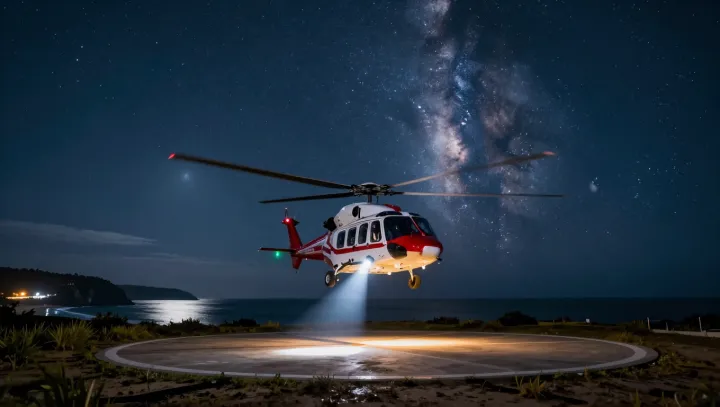
Romance is the enemy of rescue. Blue-white approach lights cut across the helipad, while the Milky Way hangs above a coast too dark for visual judgment; beneath that celestial show, the helicopter's useful world is smaller, built from attitude indicators, radio calls, and a disciplined line of lamps. Stars offer no margin. Under instrument flight rules, crews read airspeed, altitude, heading, and vertical speed as linked evidence, not as isolated numbers. The rotorcraft can meet the pad through a stabilized approach only when pilot technique, onboard avionics, and ground lighting agree. That is the real spectacle.
Light design is not decoration. A helipad's approach path supplies a fixed visual reference when sea haze, low cloud, or glare can erase depth perception, while photometry determines whether each fixture delivers usable intensity without washing out the pilot's view. The lamps do not erase risk. Wind shear can still disturb a descent, and spatial disorientation can still turn a black shoreline into a false horizon; that is why recurrent crew training treats scan discipline and crew resource management as operational defenses. Machinery earns the final word. Above the coast, the galaxy may look infinite, yet safety rests on a narrow corridor of measured motion and light.