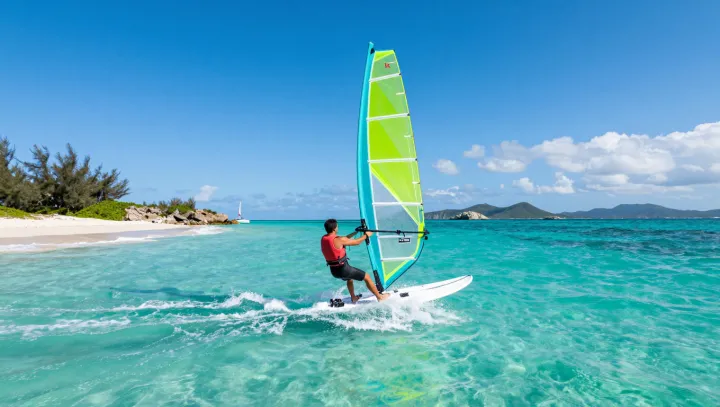
Speed is the trick. A board slicing across rippled water can outrun the air that feeds its sail because the sail does not merely catch wind; it manufactures a new airflow from motion. This is apparent wind, created when true wind and board velocity combine as vectors.
The common picture is wrong. The sail works less like a bucket and more like an aircraft wing. Its curved profile creates aerodynamic lift, a force angled sideways and forward, while the rider trims the rig at a reach rather than pointing straight downwind. The fin supplies hydrodynamic lift, resisting leeway so that sideways force becomes drive. Think of vector addition as a live routing algorithm: each knot of board speed changes the incoming flow, which can raise useful force instead of canceling it. Drag still bills every gain.
Control, not brute force, decides the ceiling. As speed rises, apparent wind shifts toward the nose, and skilled trim keeps the sail's angle of attack productive without stalling; too much sheet-in produces drag, too little loses pressure. Foils sharpen the equation. By lifting the board above surface chop, they cut hydrodynamic drag, letting the feedback between velocity and apparent wind intensify. Push that loop far enough, and wind becomes not a limit but raw input for a machine skimming its own weather.