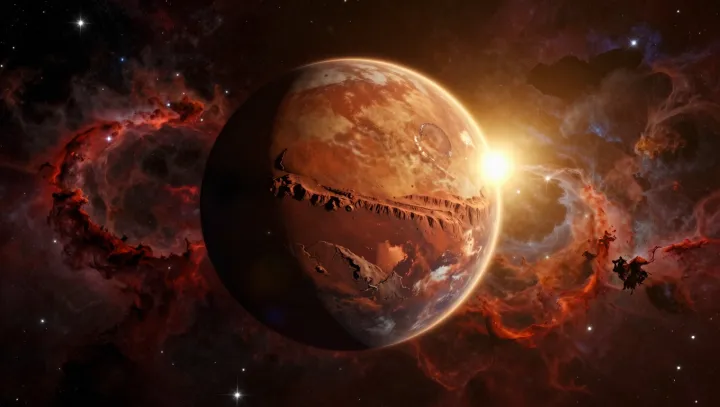
The blue is no illusion. At sunset, the solar disk sinks behind a dusty Martian horizon, and the narrow halo beside it can turn blue-gray while the wider sky keeps its rust-colored cast. It looks backward. The effect is not an alien pigment; it is sunlight sorted by airborne mineral grains.
That reversal is the point. Mars has a thin carbon-dioxide atmosphere loaded with iron-oxide dust, whose particles are close in size to visible wavelengths and therefore follow Mie scattering rather than the simpler Rayleigh pattern familiar from Earth's blue sky. Dust acts like a filter. Along the long slant path of sunset, this dust preferentially removes red and orange light from the direct solar beam. The transmitted light near the Sun consequently carries a larger blue share. Optical depth sets the strength of the effect: denser dust increases extinction, while clouds and particle size can change the result.
Think of Mie scattering as a packet-routing system, not a paint job: dust redistributes wavelengths according to particle size and scattering angle. Physics has the last word. The analogy has limits, because photons are not messages and the governing quantities are cross sections, phase functions, and wavelength-dependent extinction. Earth-trained expectations fail here. Terrestrial sunsets are shaped mainly by molecular Rayleigh scattering, which strips blue from the direct beam and leaves it red. On Mars, dust owns the geometry. A blue ring beside a setting Sun is the visible result of that selective filtering.