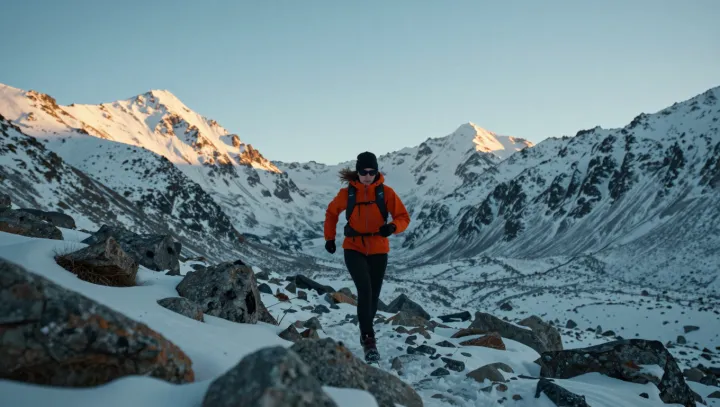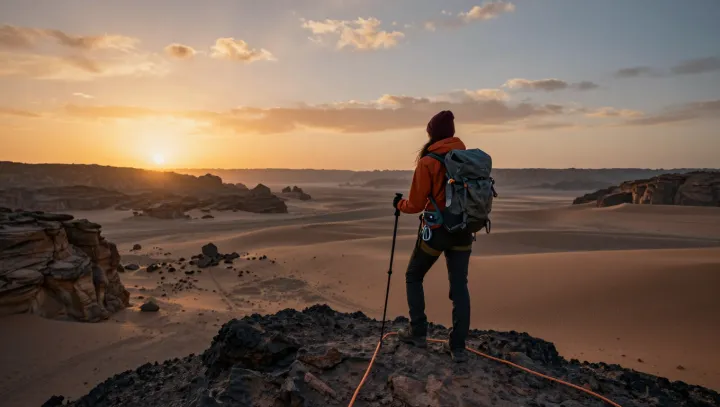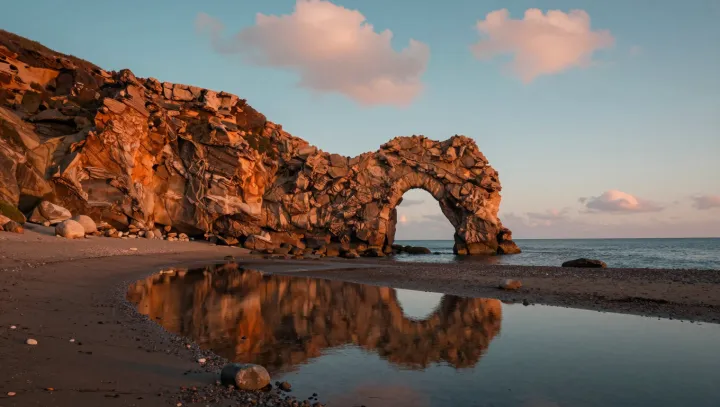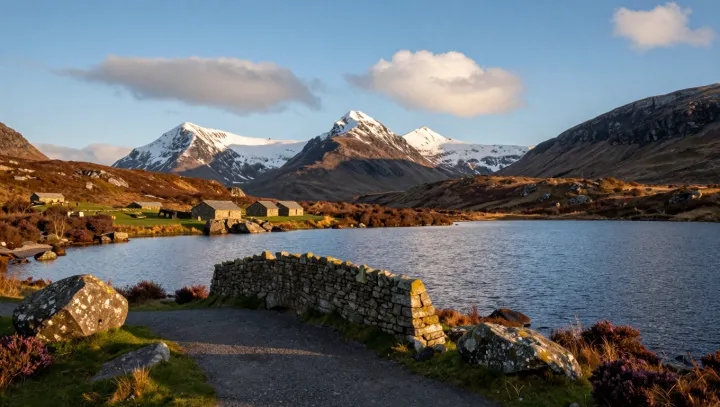
Low sunlight is an editor with a severe eye: it rakes across stone, heath, and snow rather than falling squarely upon them, separating planes that noon presses into one tone. Midday flattens the evidence. At a shallow solar elevation, each bump faces a different dose of irradiance, and cast shadows begin doing the visual accounting.
The effect is not mere romance. Rough stone has a bidirectional reflectance distribution function, or BRDF, meaning its tiny facets return light unevenly; warm side light makes that irregularity legible, while noon sends a more uniform signal. Purple heath gains an unfair advantage. Longer red and yellow wavelengths, enriched after atmospheric scattering removes more blue light from the direct beam, push its pigments toward deeper contrast against dark ground and cool shadow. Photometry, not sentiment, supplies the trick.
Snow performs the boldest reversal. Its high albedo reflects much of what arrives, yet low-angle rays carve blue-gray hollows beside lit ridges because slope orientation governs both illumination and viewing geometry. The eye reads those sharp luminance gradients as depth, scale, and danger. By noon, diffuse skylight fills the gaps. Then the peaks surrender their secrets. In the long slant of evening, matter seems less revealed than cross-examined.