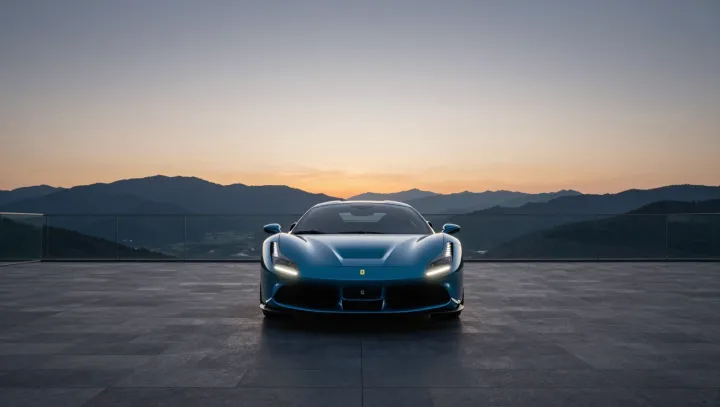
The front end gives away the answer: Ferrari did not abandon the lamp; it demoted it. A thin horizontal light graphic carries the greeting, while the working LED modules sit within a dark visor. No faux grille is needed. The result is less nostalgic than deliberate: the car announces its identity before its hardware asks to be seen.
That decision is smarter than a retro disguise. A classic grille belongs to an era when round lamps, radiator airflow, and a tall nose shared one visual stage; on a modern front fascia, those jobs have split apart. That matters on track. LED optics need little volume, while cooling ducts and aerodynamic channels need clean, accurately shaped openings. Hiding lamps behind a grille turns the front into costume and can complicate pressure management around heat exchangers, with consequences for front-axle lift. It also preserves an unbroken hood line, making the front appear lower and wider without pretending to be an old grand tourer.
More tellingly, Ferrari is selling recognition, not concealment. A wide signature gives the 12Cilindri an instant silhouette after dark, something a borrowed vintage grille cannot supply without slipping into pastiche. That is the trick. Pedestrian-impact requirements and lighting homologation also shape nose height, lamp placement, and the structure beneath the skin. The old grille promised mystery. This narrow line offers another seduction: first light, then speed, then the unresolved question of whether memory should ever dictate a machine's face.