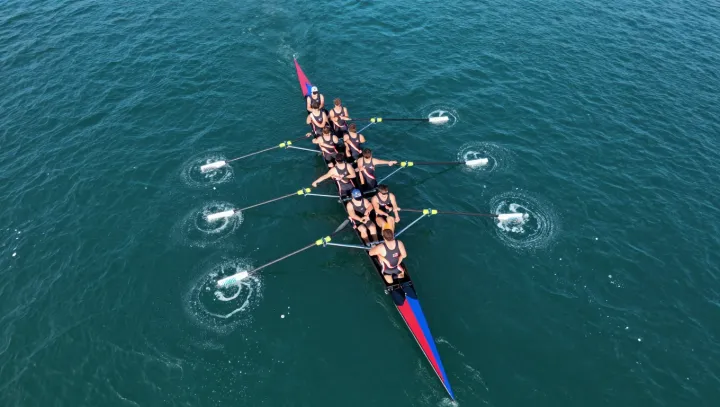
The shell runs bow-first while its rowers look toward the stern, a contradiction that makes rowing less a contest of sight than a discipline of trust. Speed is borrowed, not owned. At the catch, blades must enter together; one late blade checks the hull, breaks its run, and makes shared effort expensive.
The coxswain is not decorative ballast. Facing the course, that crew member turns distant markers, wind shifts, and rival movement into commands the rowers can use without seeing ahead. The boat obeys physics, not pep talks. During the drive phase, force travels through legs, trunk, handle, oarlock, and blade; mismatched sequencing produces yaw, while uneven blade depth raises hydrodynamic drag. A crew builds speed through repeatable timing, then protects it during recovery, when the hull's inertial run is easiest to waste.
The real marvel is harsher: individuality is a tax. Stroke rate can climb, but power without common rhythm merely shakes the shell. Forward-facing teamwork is not a slogan; it is a division of perception, with the coxswain reading the water and rowers reading pressure at the handle. Behind them lies the wake. Ahead, unseen by most, lies the line where separate bodies become one moving decision.