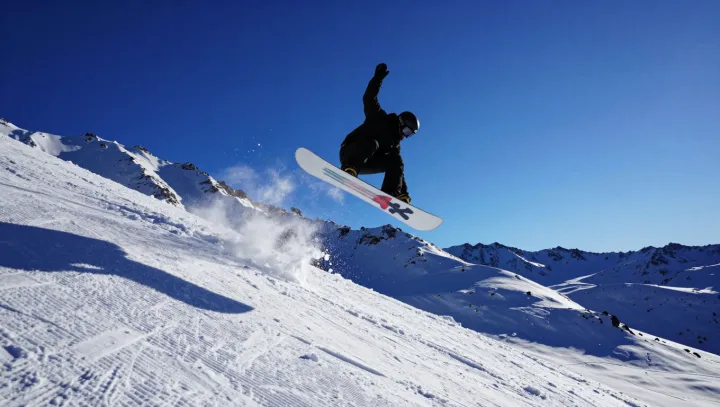
Height is the decoy. A snowboard jump is won when the rider keeps the center of mass stacked above a shrinking base of support, releases the edge at the chosen instant, and lets the board leave snow without dragging the body into a late rotation. The air is brief. Balance lasts.
The common obsession with elevation mistakes spectacle for control. At takeoff, edge angle stores and redirects force, while hips, shoulders, and knees must remain organized over the board rather than chase the lip. Tiny errors compound. A rearward center of mass can turn a clean pop into an under-rotated landing; an early shoulder opening can send angular momentum where the rider never intended. The board is a moving comma, not a catapult.
Landing, not airtime, exposes the method. The board needs to meet the slope along its running base, with ankles, knees, and hips flexing in sequence to absorb impulse and spread load. Stiff legs lose. That coordinated flexion resembles a suspension system, though its actual currency is eccentric muscle action and joint moment control. A rider who lands centered can ride away even from a modest jump; one who lands tall and backseat pays for every extra inch.
The better lesson is almost unfashionable. Train edge release, body alignment, and landing absorption before hunting amplitude, because aerial style has little value if the board returns as an argument with gravity. Keep it quiet. On snow, the most convincing jump often ends with no visible correction, only a board tracking forward and a body already prepared for the next turn.