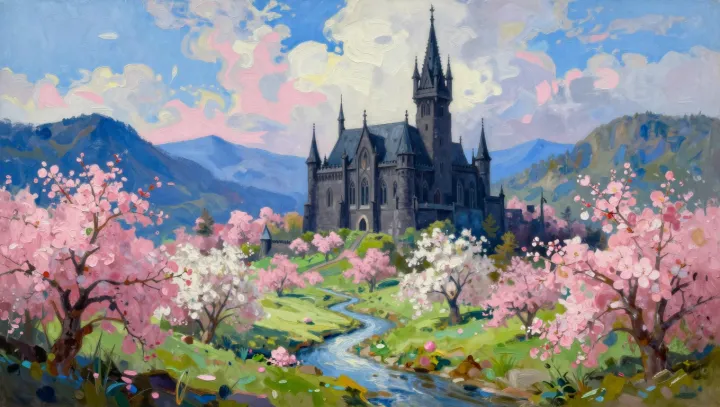
The fantasy castle owes its beauty to a practical problem: how to keep attackers out. Here, spires rise above pink blossoms and a winding stream, their edges softened by vivid, impressionist-inspired brushwork. The threat has vanished. What remains is the pleasure of imagining a fortress without a siege.
Romanticism made that transformation irresistible. As artillery and changing military tactics diminished the value of traditional castle defenses, writers and artists found fresh appeal in their ruins, treating them as reminders of chivalry, local history and a past seemingly more dramatic than industrial life. Battlements and turrets, once associated with surveillance and defense, became a visual shorthand for mystery. Memory edited the masonry. The fortified buildings that survived were rarely the clean, complete monuments that fantasy preferred.
The new castles were acts of selection rather than faithful reconstructions. Neuschwanstein, commissioned by King Ludwig II of Bavaria, borrowed medieval forms while incorporating modern comforts; at Pierrefonds in France, architect Eugene Viollet-le-Duc restored a ruined castle according to his own interpretation of medieval design. Their towers could suggest the past without having to withstand its dangers. In the painted scene, color carries that freedom further: blossoms crowd the banks, water bends toward the castle, and brushstrokes loosen the stone into something almost dreamlike. The walls still rise. No one needs to hide behind them.