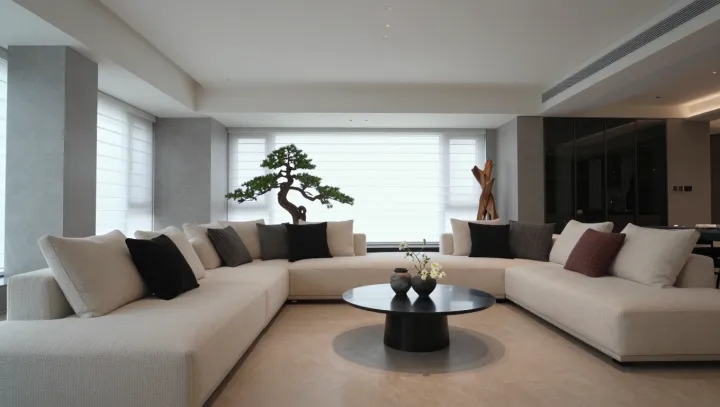
A neutral room need not be a quiet one. Here, a large light-colored sectional holds its own against stone-look walls, while contrasting cushions and a sculptural tree give the eye places to pause. The palette stays restrained. Its surfaces, shapes, and shadows do the expressive work that brighter colors might otherwise claim.
Texture is the room's strongest argument against monotony. The sectional reads as soft and yielding beside walls with the visual character of stone, so even similar shades can register as distinct materials. Light sharpens that distinction. Where it meets a textured surface, small variations in brightness reveal detail; across a broad upholstered plane, the effect is gentler. Value contrast, the difference between light and dark, gives the cushions their weight against the pale seating. They need not be vivid to be visible. A darker accent can define the edge of a seat just as clearly as a saturated color, without interrupting the room's measured tone.
The tree makes the composition less predictable. Against the long horizontal sweep of the sectional and the broad wall behind it, its branching form introduces a vertical gesture that furniture alone cannot provide. Scale matters here. A substantial sofa gives the room an anchor, while smaller cushions offer points of contrast close at hand; the tree draws attention upward and away from the seating. These elements do not compete for attention so much as take turns holding it. The resulting depth is not a matter of adding more objects, but of letting each surface and silhouette remain distinct. In the stillness of the room, even a shadow has somewhere to go.