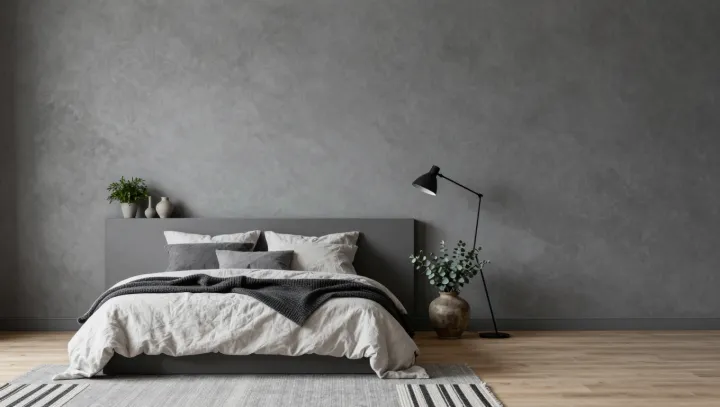
Gray needs texture, not rescue. In this contemporary bedroom, a textured wall gives light something to catch, while layered bedding, restrained greenery and black accents keep the palette composed. The result is a room with depth rather than a collection of competing colors. Its interest comes from surfaces, not spectacle.
The wall does the quietest work. Grazing light, which falls across a surface at a shallow angle, makes small variations more apparent through highlights and shadows. Diffuse reflection softens the effect as light scatters across the wall rather than bouncing back in a single direction. Even a modest change in illumination can alter the wall's appearance over the course of a day. The bedding answers with a different kind of depth: folds, seams and overlapping fabrics create their own shifting shadows. Keep the layers visible. A smooth cover pulled tight against every edge would leave less for the light to reveal.
Black accents earn their place through contrast, not volume. Against gray surfaces, a dark detail can give the eye a clear edge without interrupting the room's calm; too many such marks could make the composition feel busy. The greenery is similarly restrained, bringing an organic shape into a setting otherwise defined by planes and folds. Neither needs to dominate. What holds the room together is the space between these elements, where a crease darkens, a wall catches light and gray becomes something less fixed than a color.