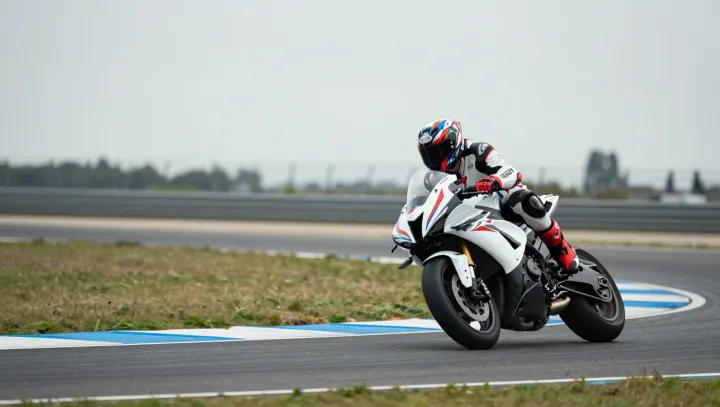
The first move is deceptive. Approaching a left-hand corner, a BMW sportbike briefly steers right so it can lean left, a maneuver known as countersteering. The racer, protected by leathers and a full-face helmet, is not choosing the wrong line; the motorcycle must first be tilted before it can turn at speed.
The tires do the persuading. A brief push on the left handlebar turns the front wheel slightly right, shifting the tire contact patches to the right of the motorcycle's center of mass. Because inertia resists an immediate sideways shift of that mass, the bike begins to roll left. The steering input need not look dramatic from trackside. What matters is the resulting lean, which allows the combined forces of gravity and tire grip to support the machine through the bend rather than topple it outward.
The backward movement is only the opening act. Once the desired lean is established, the front wheel generally points into the corner as the tires generate the lateral force needed to follow the curved path. Steering inputs continue throughout the turn; their size and direction depend on speed, lean and the motorcycle's response. Body position matters, too. By shifting inward, a racer can alter the combined center of mass and negotiate the same curve with less motorcycle lean, preserving some tire clearance. On the circuit, the apparent contradiction lasts a moment; the line it makes possible stretches all the way to the exit.