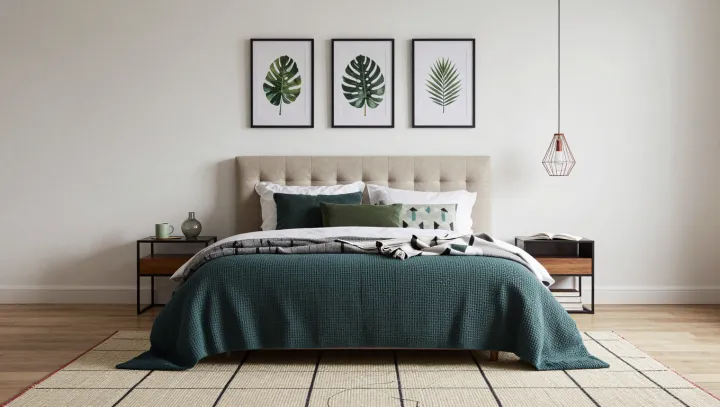
Botanical prints and geometric shapes make better partners than rivals. The reason is contrast with discipline: leafy patterns bring irregular movement, while angular pendant lights provide a clear counterpoint. Deep green textiles connect the two, and a neutral upholstered headboard gives the eye somewhere to rest. The room holds together.
Color does the quiet work. When green appears in both the prints and the textiles, it creates repetition without demanding that every pattern match; the shared hue lets different shapes read as parts of the same room. The headboard matters, too. Its neutral surface offers negative space, separating the more active elements so that each can be seen rather than swallowed by the next. A restrained palette also allows the pendant lights to stand out without introducing another competing color.
Shape supplies the room with structure. In visual hierarchy, the eye tends to register distinct forms before taking in smaller details, so the strong outlines of the pendants can help organize the softer intricacy of the foliage. The scale of each element matters: large, simple shapes can balance a busier print, while too many small patterns may compete for attention. None needs to disappear. The result is not a rigid formula but a useful tension between order and growth, held in the stillness of a bedroom.