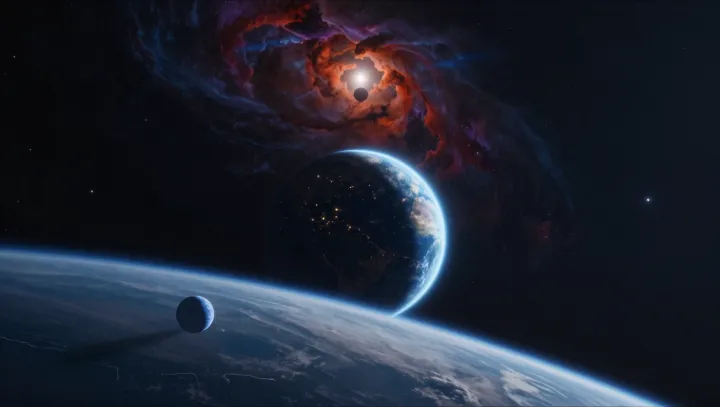
A shared star offers no guarantee of a shared climate. Earth and Venus are rocky neighbors of similar size, yet one has oceans while the other has a surface hot enough to melt lead. The distance between them matters, but sunlight alone cannot explain the full divide. Atmospheres have memories.
Venus illustrates how a planet can turn heat into more heat. Closer to the Sun, it receives more energy than Earth; if its early surface held enough water, evaporation could have strengthened the greenhouse effect, trapping more heat and driving further evaporation. This runaway greenhouse scenario remains a leading explanation, not a settled account of Venus's past. Today its atmosphere is mostly carbon dioxide, and surface temperatures average about 465 degrees Celsius. Earth took another path. Liquid water and geological processes help regulate atmospheric carbon dioxide over long periods, although the details of that regulation remain actively studied.
Habitability is therefore less an address than a history. Astronomers use the habitable zone to identify orbits where surface liquid water might be possible, but a planet in that zone can still be dry or wrapped in an inhospitable atmosphere. Spectroscopy can reveal some atmospheric gases, though clouds and limited observations can obscure the evidence. A rocky planet near a distant star may resemble Earth in size while concealing a climate closer to Venus's. The distinction is difficult to see. Beneath the same light, two worlds can keep very different secrets.