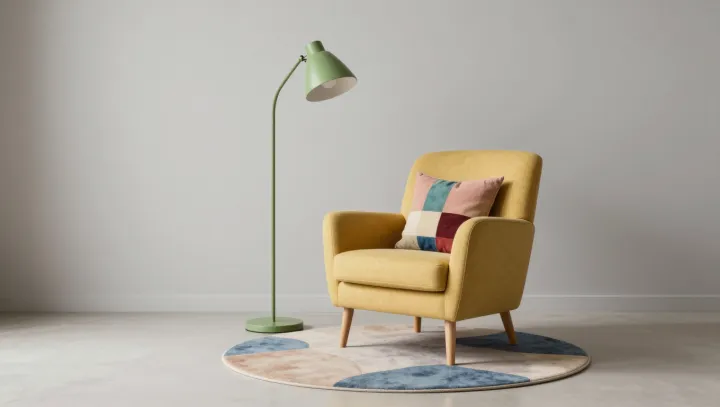
The quiet Scandinavian room has been oversold. A simple upholstered armchair on wooden legs, paired with a bright floor lamp and patterned textiles, makes a different case: restraint in furniture can give color room to speak. The arrangement feels coherent not because everything matches, but because each element has a distinct job.
Minimalism is only part of the story. Scandinavian weaving has long included vivid geometric motifs, while Swedish designer Josef Frank created exuberant floral prints for the furnishings company Svenskt Tenn. His work complicates the familiar image of pale wood and empty surfaces. So does the broader Nordic textile tradition: Finnish company Marimekko, for example, built its identity around bold printed fabrics. Finland is Nordic rather than Scandinavian in the strict geographic sense, but its design has often been grouped with that of its neighbors in international markets.
The neutral stereotype has a commercial logic. Clean-lined furniture and light interiors are easy to photograph, reproduce and sell as a recognizable style; a regional tradition with many colors and competing tastes is harder to package. The corner resists that narrowing without abandoning simplicity. Its wooden legs provide visual lightness, the upholstery supplies a calm base, and the lamp and textiles introduce contrast. The prints need not match precisely: a shared color or a balance of scale can hold them together. In that small space, the supposed opposition between restraint and exuberance settles into the same chair.