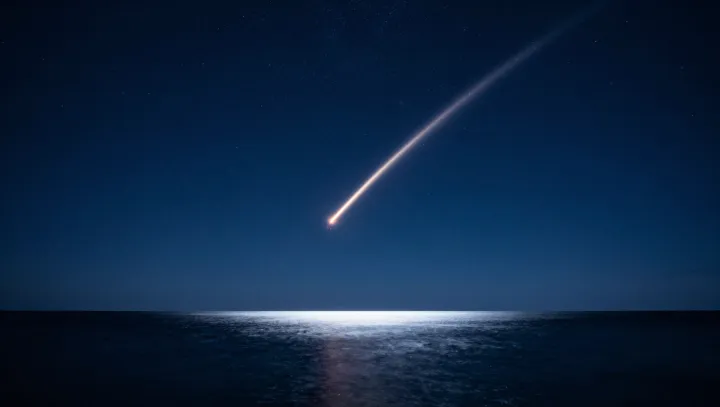
A meteor's brilliance has little to do with its size and much to do with its speed. A speck no larger than a grain of sand can race into the atmosphere at tens of kilometers per second, carrying enough kinetic energy to turn a brief passage into a conspicuous streak. Speed changes the arithmetic.
The streak is not simply a glowing pebble. As the meteoroid collides with atmospheric molecules, energy is transferred to the surrounding gas and to the intruder's surface; the surface heats up, and material vaporizes in a process called ablation. Those collisions also excite atoms and molecules, raising their electrons to higher energy states. When the electrons fall back, they release photons. The light comes from both atmospheric gases and vaporized meteoroid material, spread along the object's path. The distinction matters. What the eye follows is a luminous trail, not a grain visibly burning like a match.
The apparent scale of the display can deceive. Most visible meteors occur roughly 70 to 120 kilometers above the ground, where even thin air presents a formidable obstacle to an object moving so quickly. Because kinetic energy rises with the square of speed, doubling a particle's speed gives it four times as much energy at the same mass. That energy is released rapidly, though only a fraction becomes visible light. Most tiny meteoroids vaporize before reaching the ground; larger pieces that survive the descent are called meteorites. For a moment, an almost invisible fragment writes itself across the dark.