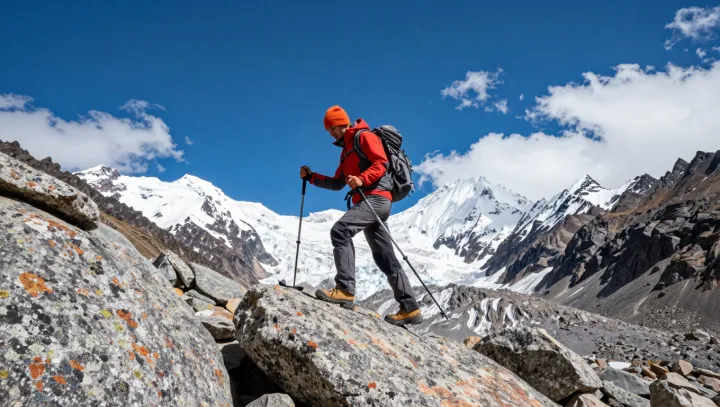
The descent can be the mountain's sharpest lesson: breathing eases, yet legs may pay more for the journey down than for the climb. Gravity supplies the movement, but it also demands a brake, one applied repeatedly by muscles as boots meet uneven ground. The bill arrives later.
The apparent bargain is deceptive. During a descent, the quadriceps often perform eccentric contractions: they lengthen under tension while controlling the bending of the knees. That braking work can produce microscopic muscle damage and contribute to delayed onset muscle soreness, which may emerge after the hike rather than on the trail itself. Climbing, by contrast, generally asks the heart and lungs to supply more energy as muscles lift the body against gravity. Easier breathing is therefore a poor measure of the strain on your legs. Neither soreness nor its absence is a reliable measure of a workout's value.
Preparation pays better than bravado. Mountain hikes offer aerobic exercise and views across ridges and valleys, but loose footing and changing weather can turn a straightforward route into a demanding one. Build distance and descent gradually, check the forecast, carry water and suitable layers, and choose footwear with reliable grip. Trekking poles may help with balance and reduce some load on the legs; they cannot make unstable ground safe. Turn back when conditions exceed your experience. The summit may command the eye, but the quiet work of getting home begins with the first step away from it.