An Earth sized planet in the habitable zone could be a furnace, not a second Earth. The zone marks distances where liquid water might exist on a surface under suitable atmospheric conditions; it does not promise an ocean. Venus offers a warning. Similar in size to Earth, it has a surface hot enough to melt lead.
Atmosphere is the difference that matters most. Venus has a dense envelope dominated by carbon dioxide, a greenhouse gas that traps heat, while clouds of sulfuric acid conceal its surface. Its history remains contested, but a runaway greenhouse effect could cause a wet planet to lose much of its water: warming produces more water vapor, which traps more heat, potentially allowing water to escape to space after sunlight breaks it apart. An orbit alone cannot reveal whether that happened elsewhere.
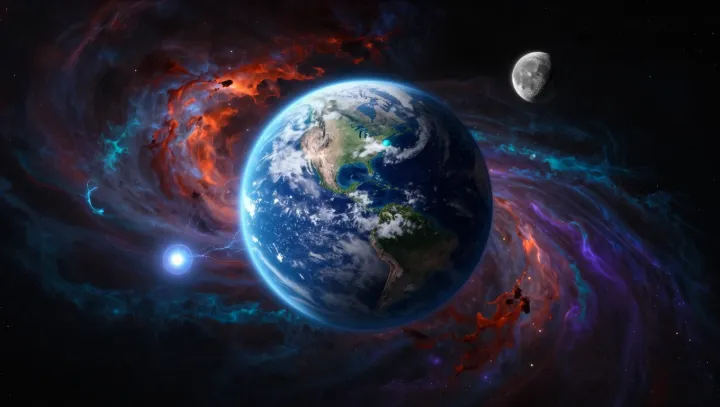
Light offers the best chance of finding out, although it can also mislead. Transit spectroscopy examines starlight filtered through a planet's atmosphere, while direct imaging seeks to separate a planet's faint light from its star's glare. Both methods may reveal gases; clouds, weak signals and overlapping spectral features can make their interpretation difficult. Carbon dioxide alone would not prove a planet is Venuslike, just as oxygen alone would not prove life: nonbiological processes can produce it. No extraterrestrial civilization has been confirmed. Between a telescope's faint spectrum and the blue world in an illustration lies a question that distance has not yet answered.