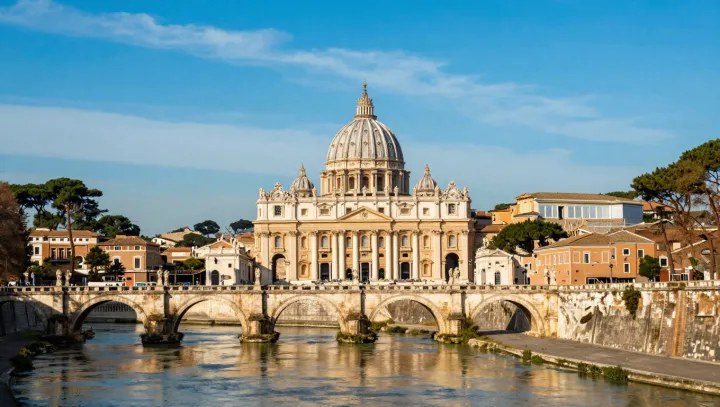
Many paintings inside St. Peter's Basilica are not paintings at all. They are mosaics, assembled from tiny pieces of colored material to resemble brushwork. The substitution was practical. In the vast stone church above the Tiber, painted altarpieces faced damp conditions that could damage both their surfaces and their supports.
The illusion carries a material argument: glass and stone can endure where paint on canvas may struggle. Mosaic workers set small pieces called tesserae into a prepared bed, matching colors and shading closely enough to reproduce the effects of a painted original. In St. Peter's, mosaic copies took the place of numerous altarpieces; some original paintings were moved elsewhere for protection. From the floor, the joins can disappear, leaving an image that seems made by a brush rather than by thousands of separate pieces.
A stone church, however magnificent, is no neutral container for art. Moisture can enter masonry, while condensation forms when humid air meets a sufficiently cool surface; soluble salts can also migrate through porous materials and crystallize as moisture evaporates. Mosaics are not immune. Their setting beds and tesserae still need inspection and conservation, especially where moisture weakens the material holding them in place. The choice was not between permanence and decay, but between different vulnerabilities, different costs, and different kinds of care. Beneath the dome, the likeness of a painting rests on a multitude of small, hard surfaces.