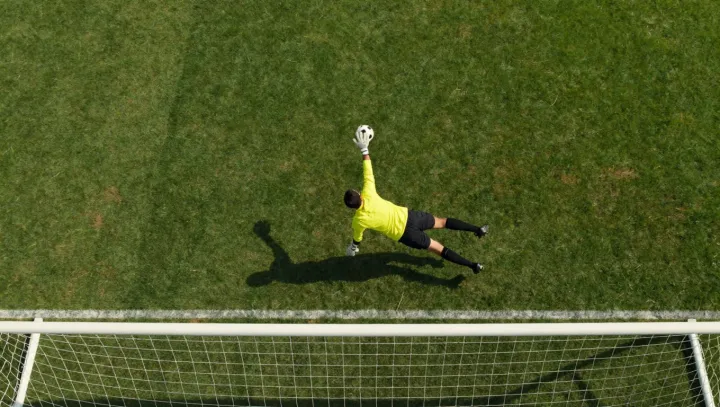
The penalty is a wager on the near future. A goalkeeper who waits to see exactly where the ball is going may already be too late: a hard shot can cross the distance from spot to goal before a full stretch can cover the corner. The dive often begins before certainty arrives.
Anticipation, not reflex alone, gives the goalkeeper a chance. The angle of the run-up, the position of the plant foot and the rotation of the hips can offer clues about the intended direction, although none is a guarantee. A kicker can disguise those signals or change the strike at the last moment. Past penalties may also reveal a preference, but a habit is not a promise. In perceptual terms, the goalkeeper is reading advance cues while weighing them against prior information; the decision is made under pressure, with incomplete evidence and a narrow margin for correction.
An early dive carries its own price. Commit to one side and the other opens up, leaving a calm kicker room to send the ball elsewhere or down the middle. Some goalkeepers therefore delay their movement, trusting their reach and reaction time rather than choosing too soon; others make small movements to invite a particular shot. The laws add another constraint: at the kick, the goalkeeper must have at least part of one foot on, above or behind the goal line. For all the preparation, the moment remains a contest between two people trying to read an intention that has not yet become an action. Then the ball moves.