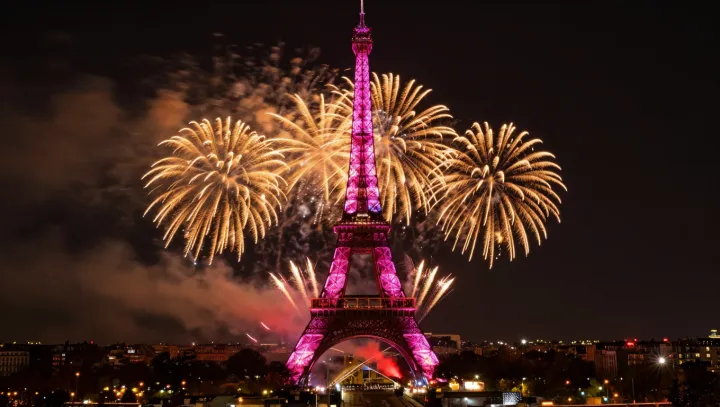
The Eiffel Tower is less rigid than it looks. Gold and pink fireworks illuminate its iron lattice in Paris, revealing a structure that changes shape with the weather. Heat makes the metal expand, so the tower can stand taller in summer than it does when its framework is cold.
The explanation is ordinary physics, not structural failure. Thermal expansion occurs because atoms in iron vibrate more as temperature rises, increasing their average separation. The change is tiny at the scale of a rivet. Across a tower more than 300 meters high, those small increases accumulate: under sufficiently hot conditions, its height can increase by roughly 15 centimeters. The precise change depends on the temperature of the metal, which need not match the air around it. As the iron cools, it contracts again.
Height tells only part of the story. Uneven heating can make one side of the framework expand more than the other, causing the tower to lean away from the sun. Engineers account for such movement because a structure that cannot accommodate expansion can develop thermal stress. The fireworks fade quickly. Long after the light has left its lattice, the tower continues its quiet negotiation with the air.