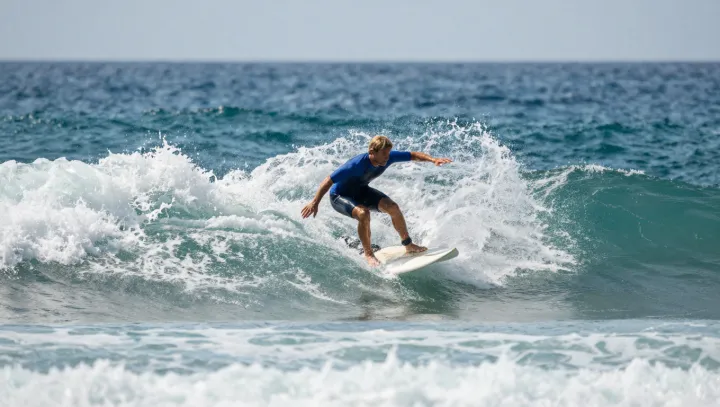
The fastest route down a wave is rarely straight toward shore. A surfer who angles across its face can stay near the steep, breaking section, where gravity supplies speed and the moving wave continually offers fresh terrain. Straight ahead lies the flatter water, and a ride that may soon lose momentum.
The turn is an engine of opportunity, not a free source of energy. Gravity pulls the surfer down the sloping face; a bottom turn then redirects that motion across and upward, using the board's rail and fins to grip the water. Height becomes useful again. By descending from higher on the face, the surfer can trade gravitational potential energy for kinetic energy, while careful shifts in weight help the board follow the wave's shape. Pumping, a sequence of compressions and extensions, can also help maintain or build speed, although mistimed movements and drag can slow the board.
Speed matters most when it serves control. In competition, a surfer needs enough pace to link maneuvers and reach sections where the wave permits forceful turns; a fast line alone is not the same as a strong score. Turn too sharply and the board may shed speed; stay too high or too far ahead and the rider can leave the steep face behind. The choice is delicate. At the edge of breaking water, motion depends on knowing when to descend and when to hold the line.