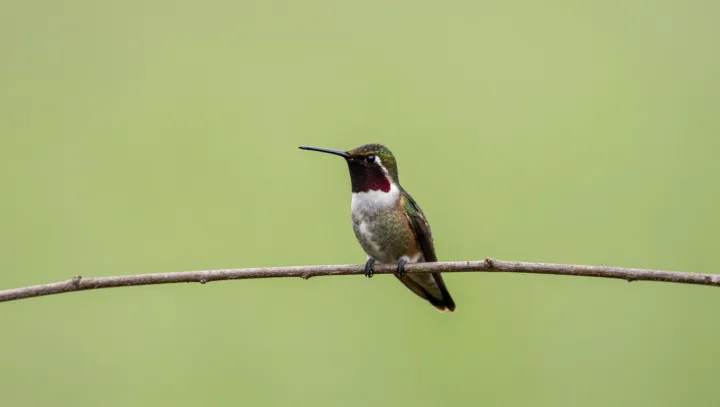
Backward flight begins with a twist, not a reverse gear. A hummingbird rotates each wing at the shoulder as it sweeps through the air, changing the angle of its feathers at the end of each stroke. The result is unusual control: the bird can sustain lift while shifting position without turning its body.
The upstroke earns its keep. Unlike most birds, hummingbirds generate a substantial share of their weight support on the upstroke, although the downstroke generally produces more. Wing rotation changes the angle of attack, allowing the wing to redirect air downward on both halves of the cycle. A leading edge vortex, a swirling region of air above the wing, can help produce lift as the wing moves. The motion is not a perfect figure eight traced by a rigid blade: the wing bends and twists, and its path varies with the task.
Going backward demands more than lift. By adjusting wing orientation and stroke motion, the bird tilts the aerodynamic force so that part of it acts toward the rear, while enough still points upward to counter gravity. Air is pushed forward as well as downward. The bird also adjusts its body posture and tail to help control its position, making constant corrections as it leaves a flower. The maneuver costs energy, but it buys access to nectar without the space needed for a turn. For an instant, departure looks much like arrival run in reverse, though the forces beneath those blurred wings tell a more intricate story.