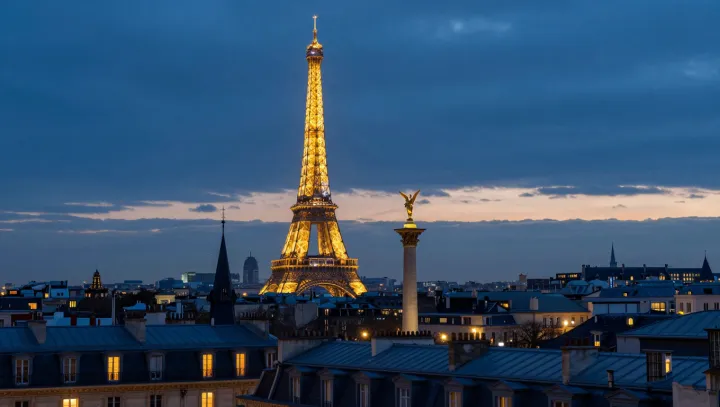
The Eiffel Tower's glow at dusk conceals a practical argument in iron. Its legs sweep inward as they rise, giving the Paris landmark a silhouette shaped not merely for elegance but for survival against the wind. The curve does work. Beneath the lights is an answer to a demanding engineering problem.
The tower's broad stance is its first defense against overturning. Wind pushes sideways on the structure, creating a bending moment that grows toward the base as forces from above accumulate. The curved legs help redirect those forces into compression and tension along the iron framework, while their wide separation provides leverage against the tendency to tip. Less material is needed near the top, where the accumulated load is smaller; more is concentrated below, where the demands are greater. Shape follows force.
The open lattice is just as important as the outline. Air can pass through gaps between the iron members, reducing the area directly exposed to wind compared with a solid structure of similar dimensions. Cross bracing helps stiffen the framework, though the tower still moves slightly in strong gusts. Built for a World's Fair and later embraced as a symbol of France, it wears its engineering lightly. At dusk, the illuminated iron seems almost weightless; its curve tells another story.